
Thursday, May 1, 2014
An uncertain future for the Museum?
The Museum's halls have been fairly quiet lately, I admit. Don't worry; I'm not closing the place down yet. It's simply that 1) life has been demanding a lot more of me than usual, and 2) I'm running out of Items to post! I'll keep doing the Revisited series when I can, but I need to look for more things.
I'm about to go on a vacation to Florida in a few weeks, so I'll look into hitting a couple of flea markets and resale shops while I'm there. Making no promises, but they should yield some interesting results.
I do have "Dracula 2000," "Godzilla 2000," "Pokemon The Movie 2000," and the series "Millennium" at the back of my head, but most of those should be for Halloween.
Ooh, here's an idea: Saturday, June 7th, is the 30th Anniversary of Ghostbusters. It might be a good idea for me to review the 1999 "15th Anniversary" DVD, and its first DVD release. As far as I know, it was one of the first titles to really show off what the format could do, because it's packed to the gills with documentaries, concept art, storyboards, animated menus, and scads of other features. The standout is the "Video Commentary," during which writer Harold Ramis mentions the New Millennium. I'm not saying a word about the context, but let's just say that it casts the movie in a whole new light.

Thursday, April 3, 2014
FO-O-O-ORE! It's the Masters' 2000 Journal!

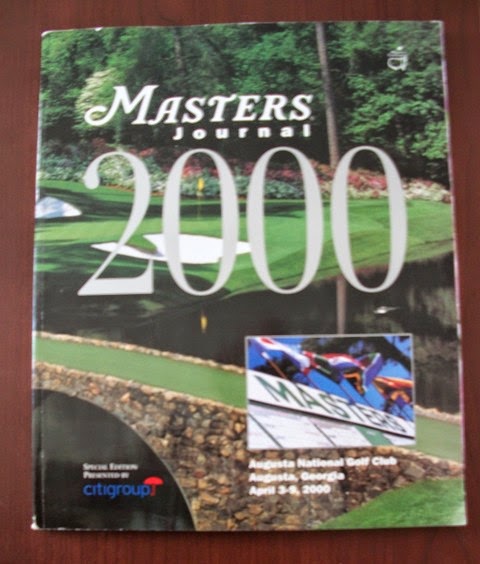
Let me begin this article with an admission: I am
not an avid sports fan. Certainly, I’ll check in on the Super Bowl, the World
Series, and the Olympics (though Sochi was the first Olympic Games that I
actively avoided), and I’ll take in the awe and spectacle, but afterwards, it’s
all just a game to me.
The same applies to the Masters, which is, in a
word, the World Cup of golf. I bought this journal not because I follow golf,
but because 1) it’s a Year 2000 item, and 2) that year, the Masters opened on
my birthday (April 3rd). It came from the St. Vincent de Paul Thrift
Store in Midlothian, IL, where I've found one or two very good Millennium Artifacts in the past
year.
(Oh, just as a heads-up, the Masters Tournament will start next Monday.)
…So, the Masters 2000 Journal. At the time,
Citibank (or Citigroup, as it was known) provided backing for the tournament,
and there are one or two ads for the corporation. At the time, Citibank had
just bought Travelers Insurance and undergone a huge rebranding effort. Gone
were the days of the italicized, all-caps “CITIBANK” logo—gone were the days of
“CITIBANK,” actually—this marked the age of “CITI” and “CITIGROUP” in a simple,
all lower-case font. Also, the red Travelers umbrella appeared at the end of
the word “Citigroup;” it’s now a stylized red arc that sits on top of the “t”
and covers the two “i’s.”
Enough about banking and financing; what about the
rest of the book? It fits the “time capsule” mandate of the Millennium Museum
quite well. It starts out with a five-page section about the Masters’ humble
beginnings, and after that there’s a decade-by-decade “potted history,” which
recaps each year’s tournament, tells us who won that year, and offers up a few
interesting highlights. For example, in 1997, a 21-year-old Tiger Woods became
the youngest winner in Masters’ history.
The entry says, “…Tiger Woods re-wrote [sic] a good portion of the tournament’s
record book. His 270 total and 12-stroke margin of victory were two of 20
records the 21-year-old established. His play in Amen Corner—seven under par
for the four rounds—was instrumental in his becoming the youngest Masters
champion” (Masters 25).
The book only goes up to 1999—I assume this is
because it was released well before the 2000 edition had even begun. The winner
that year was Spain’s Jose Maria Olazabal, who had previously won the British
Boys’ tournament; the British Amateur Championship; the British Youths’
tournaments; and the 1994 Masters (Masters 44). Few people knew at the time
that Olazabal was playing through a foot ailment that first started in 1993,
and after he won in ’94, it got so bad that he needed surgery.
By 1995, he was almost completely debilitated.
In 1997, he sought the help of a Munich-based
specialist, who diagnosed him with “nerve pressure in his lower back that was
affecting muscles in his feet” (44), and so began his recovery. Though he was
always humble, Olazabal’s illness put everything into a new perspective: “After
what I have been through, golf gives me a different feeling, a
determination…I’ve had the chance to have the best cars and to be able to build
a house with enough room to bring my parents to live there with me. I am paying
them back. That is what I enjoy, to see them happy” (45).
The next section of the book is a play-by-play
dissection of the course. Each of the eighteen holes takes its name from a
flower (Holly, Azalea, etc.), and each has its own difficulty grade. You may
recall a passing reference to something called “Amen Corner” earlier, and now
is a good time to explain what that is—in fact, the section opens with “Prayers
at the Heart of Amen Corner.”
Though it’s officially named Golden Bell, the
twelfth hole on the course has quite a nasty reputation. To put it simply: As
Blackbeard once struck terror in the hearts of merchant sailors, Amen Corner
strikes terror in the hearts of hardened professional golfers. If you beat it
and still remain under par, it will be by an act of divine intervention, hence
“Amen.”
Its reputation is fourfold: First, Rae’s Creek serves
as a giant water trap. Second, the putting surface is “100 feet wide but just
27 feet deep at its narrowest point” (72), which is itself surrounded by three
sand traps, or “bunkers.” Third, the course is designed so that the hole is on
top of a small hill. Fourth, and finally, an ill wind can send the ball rolling
down that incline.
Here’s a good article about this most feared part of
the tournament: "Amen
Corner: What's in a Name?"
The final section of
the book is a list of the 92 competitors that year. Among them were Tiger
Woods, Jack Nicklaus, and Arnold Palmer, as well as Vijay Singh from Fiji and
Nick Price from Zimbabwe. I’m not going to go into detail about this part, but
Masters.com has plenty of information available.
Sunday, February 16, 2014
The first in the "Revisited" series.
When I first opened the Millennium Museum, the
original intent was simply to catalogue and comment on items I already owned or
had yet to encounter, and there was a heavier emphasis on “collecting.” It
wasn’t until much later on that I started to notice and pick up on recurring
themes within each item.
From there, what began as a checklist gradually
turned into a jigsaw puzzle; the weekly posts served to complete the larger picture.
(Is it a conventional jigsaw puzzle or one of those “Puzz-3D” things that were
so popular around 2000? I’m not really sure.)
With the new focus in mind, I looked at the older
stuff from almost all of Series 1 and 2. The articles lack content, depth, and
plain old “good writing,” but within that you can see how the Museum itself has
grown and changed over the course of a year.
The “ABC 2000 Millennium Highlights” video should be
the best place for me to start. I’ll be blunt: I’m sorely, sorely disappointed
with what I wrote for it—a picture and a short paragraph with a snarky,
unprofessional tone. In context, though, the Museum started as a Cake
Wrecks-type blog, and I thought I wouldn’t need to put too much work into it.


I bought this videotape in June 2012 at our local
Salvation Army Thrift Store. I’d already been there several times, and the
place had at least three dozen copies on the shelves. Naturally, I looked right
past them every single time…until 2012, when the different concepts and items
that would eventually form the blog that you’re reading right now first came
together. In fact, this was the first thing I actually bought specifically for the site. The original idea was to report
on things I already owned, but I realized that sticking to that plan would mean exhausting my material.
Right at the beginning, this is a record of recent
history; a snapshot of a moment in time. We’re seeing the classic ABC News
lineup—Peter Jennings, Diane Sawyer, Sam Donaldson, and the others, all at the
height of their power and jubilant at the prospect of a new century. Together,
they take you all around the world, and you get to see how countries such as
Russia, Australia, France, the United Kingdom, China, and many others rang in
the New Millennium.
The program on the tape looks primitive compared to
what we’re used to today, but I think that’s only because it’s actively trying to look high-tech. We’re marking
our journey around the world with a spinning CGI globe, which was actually
pretty well-detailed and lifelike for 1999/2000. The set looks a little bit
old-fashioned in places, but again, that’s what we were used to. Nowadays,
everything looks modern
by virtue of looking timeless. (I’m
convinced that much of the “set” we see on the major network news shows is a
green-screened background with a few physical elements.)
Our first stop is the island nation of Kiribati,
which competed with the neighboring Tonga to be the first one to ring in the
New Millennium. The small nation successfully petitioned to have the
International Date Line, at the 180th Meridian, moved so that all of
the islands within that area could celebrate at the same time. Fourteen years after its little victory,
however, Kiribati is in some major trouble: Sea levels have risen thanks to
climate change. Most of its inhabitants have fled to neighboring Australia, New
Zealand, and Fiji, but they no longer
have a place to call home.
Peter takes us to Tonga, Fiji, Australia, and
finally to New Zealand, where he has a chat about possible Y2K problems with
Jimmy Walker of New Zealand's National Incident Monitoring Center. Mr. Walker
cheerfully states that there are no problems outside of the national analog
cell-phone network being jammed (par for the course on Christmas, Mother's Day,
etc.) He also pulls out an ATM receipt dated 1/1/00, 3 seconds into the new
year.
We zoom to London, where we join Charlie Gibson.
Here, in our “preservation of history” segment, we get a history lesson about
“Auld Lang Syne.” Way back when, Scottish poet Robert Burns traveled throughout
his home country, collecting poems along the way. “Auld Lang Syne” was one of
these—it's stated that he overheard an old man singing it, and he immediately
transcribed it. Later on, Burns would clean up the verses and add a new melody.
Its title literally translates as “for old time's sake,” and it was a
traditional parting song. As the people of Scotland left in search of a new
world many years after Burns died, they took the song with them. Many people heard that song, most notably a big-band
conductor named Guy Lombardo. To this day, ABC's “New Year's Rockin' Eve” special plays
that Guy Lombardo recording at midnight (New York time).
More interesting is Cokie Roberts’ coverage from
Vatican City. At the time, she did coverage for ABC World News Tonight, and, as
she mentions in the video, her mother, Lindy Boggs (1916-2013), was the U.S.
Ambassador to the Holy See, a position now held by a one Ken Francis Hackett.
In a special mother/daughter interview that went out, Ms. Boggs said that, for
her, the best part of the past century was having “members of the family who
are able to express what our country is all about; what world peace is all
about; and what this celebration is all about….This celebration is absolutely
marvelous.”
Meanwhile, in Bethlehem, we hear the following from
field correspondent Bill Blakemore: “This is the night they’ve been waiting for
a long time…The year 2000 is supposed to be a year of great peacemaking here in
the Middle East, with the Israelis, Syrians, and Palestinians, all in different
peace negotiations. There is some hope here that, by the time this millennium
year is over, it will be, as one Israeli said, ‘a very different Middle East,’
with the Israeli conflict well towards being something in the past.”
Unfortunately, this has not come true. On Tuesday, February 12, 2014, the Syrian
cease-fire agreement ended, and the fate of the region is uncertain.
Most touching of all is Peter Jennings’ little chat
with perennial New Year’s host and “America’s oldest teenager,” Dick Clark, who
had hosted the “New Year’s Rockin’ Eve!” on ABC since 1972 and, for those of us
born in the 80s and 90s, he was New Year’s Eve personified. Here he is, in his prime, with a healthy glow about
him, and rarin’ to go for the ball to drop.
All that changed in 2004, when he suffered a stroke
less than a month before the 2004/2005 New Year’s Eve broadcast (“At the stroke
of midnight,” someone no doubt quipped). From that point on, Dick became ever
more marginalized until his death in 2012. Ryan Seacrest now hosts the special,
but it’s still “Dick Clark’s New Year’s Rockin’ Eve!”, and so it shall be for
many years to come.
(I’ll pause here to mention that 2013’s celebration
featured the most amazing tribute to Dick Clark. Throughout 2012, New Yorkers
in and around Times Square wrote their memories of watching his specials and
posted them in a special exhibit. On that New Year’s Eve, those memories
showered out over the crowd as midnight confetti. That there was one of the
very best sendoffs anyone could ask for.)
The Jennings/Clark interview carries even more
weight when Peter mentions that he’s going to give up smoking as a new century
resolution.
On that bright and innocent and jubilant night, the
future seemed wide open.
On a bright and innocent day more than a year later,
terrorists flew commercial airliners into the World Trade Center.
On that dark
and markedly less innocent day, Peter Jennings’ old habit came back in full
force in response to the horrifying events that had transpired.
On August 7th, 2005, lung cancer claimed
Peter Jennings’ life, just as 9/11 claimed the life of the Millennium Era, and
with it, the dream of living in a fully interconnected and empathetic world.
That's what the Millennium Museum is all about...keeping the memory of that dream alive.
Sunday, January 26, 2014
Adding a new concept: "The Millennium Museum Revisited"
Okay, let me make one thing clear: I'm having major problems with designing an exterior structure for the Museum. (This is why I didn't take up architecture as my major...) I just can't seem to come up with anything that actually works!
Therefore, I'm ditching the whole "how the Museum might look in the real world" concept for now. Instead, I'll dig into the older Items and take a second, more in-depth look at them, this time keeping in mind how they fit in with the larger framework of the lead-up to the year 2000. These articles will fall under the umbrella banner of "The Millennium Museum Revisited," and will appear alongside newer material as I find it.
Therefore, I'm ditching the whole "how the Museum might look in the real world" concept for now. Instead, I'll dig into the older Items and take a second, more in-depth look at them, this time keeping in mind how they fit in with the larger framework of the lead-up to the year 2000. These articles will fall under the umbrella banner of "The Millennium Museum Revisited," and will appear alongside newer material as I find it.
Sunday, January 19, 2014
Life updates that aren't really "connected" to the Museum, but still...
Big news, everyone!
I've started a class at Moraine Valley that looks like it'll take up much of the time I'd otherwise use to design the Museum, BUT it should be invaluable in overhauling the blog site from time to time. You see, it's a class in Management Information Systems, and there's a heck of a lot about web design in it. If all goes well, and if I apply what I learn, then we could be looking at a Millennium Museum 3.0 in the near future! How about that, eh?
Meanwhile, here's something I did for fun a little while ago:

I've started a class at Moraine Valley that looks like it'll take up much of the time I'd otherwise use to design the Museum, BUT it should be invaluable in overhauling the blog site from time to time. You see, it's a class in Management Information Systems, and there's a heck of a lot about web design in it. If all goes well, and if I apply what I learn, then we could be looking at a Millennium Museum 3.0 in the near future! How about that, eh?
Meanwhile, here's something I did for fun a little while ago:
It's my little riff on the Golden Tickets from Roald Dahl's Charlie and the Chocolate Factory. The difference here, is, the Silver Ticket gets you into the Museum at any time you want!
I did all of this in Microsoft Word within the space of two hours or so, most of which went into the large logo at the top of the ticket. (A "word" to the wise: Merging a bunch of distinct elements into a single, unified image is more of a pain than it should be. Once you have it all merged, resizing it deforms the image somewhat. Bear in mind, though, that I'm still working from Word 2007.)
Sunday, January 12, 2014
First post of the new year.
Hi, everyone!
Sorry it's been so long since I last posted (New Year's Eve), but my internet connection's been on-and-off throughout the week. I blame that sudden cold snap....
On the last night of 2013, my original plan was to shut down for a couple of months, but another idea came up since then: Why not do a "Museum-lite" season? I'll still be online, but you won't see any items. Instead, I'll take you behind the scenes as I design and "construct" an exterior for the Museum. My goal for the next official season, two months from now (this is at the earliest), is to finish off the key illustration for the Museum campus. At the moment, I'm still kicking around an idea or two, but the overall idea is a whimsical cross between the Times Square building and Willy Wonka's factory, with a little bit of EPCOT and the House on the Rock thrown in for good measure.
Sorry it's been so long since I last posted (New Year's Eve), but my internet connection's been on-and-off throughout the week. I blame that sudden cold snap....
On the last night of 2013, my original plan was to shut down for a couple of months, but another idea came up since then: Why not do a "Museum-lite" season? I'll still be online, but you won't see any items. Instead, I'll take you behind the scenes as I design and "construct" an exterior for the Museum. My goal for the next official season, two months from now (this is at the earliest), is to finish off the key illustration for the Museum campus. At the moment, I'm still kicking around an idea or two, but the overall idea is a whimsical cross between the Times Square building and Willy Wonka's factory, with a little bit of EPCOT and the House on the Rock thrown in for good measure.
Tuesday, December 31, 2013
Happy New Year, one and all!
I know it'll be a few hours until we ring in the New Year, but it's been a l-o-n-g day at work, and I'd like to see my annual tradition through before I do anything else. (If I don't do it now, I'll forget.)
First, the banner. I don't know who did that panorama of Times Square or where I got it from, so whoever made it, I thank you for an absolutely beautiful image! Let's give a big hand to whoever made that picture!
Second, the first official New Year's custom logo.

Third, I'd like to turn back the hands of time before the clock chimes midnight, and ring in a new tradition that I like to call "The Millennium Museum's Personal Best."
Ready? Buckle up, 'cause here we go!


First, the banner. I don't know who did that panorama of Times Square or where I got it from, so whoever made it, I thank you for an absolutely beautiful image! Let's give a big hand to whoever made that picture!
Second, the first official New Year's custom logo.

Third, I'd like to turn back the hands of time before the clock chimes midnight, and ring in a new tradition that I like to call "The Millennium Museum's Personal Best."
Ready? Buckle up, 'cause here we go!
DECEMBER 22nd, 2012:
The Millennium Museum opens. The first Item displayed is a
Year 2000 face-towel. The original
DECEMBER 31st, 2012:
The Museum’s first New Year’s Eve; the next Items are Doctor
Who: The Movie
and a Danbury Mint Millennium Baby.
JANUARY 1, 2013: The Museum unveils its logo!
FEBRUARY 4: The “On This Day”
feature debuts. I admit with some shame that it has fallen by the wayside because it got too hard to do without a handy articles database. (I'm taking a class at Moraine Valley in the new year, so with that I should get access to the news databases.)
MARCH 17: St. Patrick’s Day
inspires the creation of a prototype “custom logo.” In this case, the banner’s
usual silver gradient changed to the colors of the Irish flag. Little else
changed, but the seed of an idea was born.
APRIL 3: In the real world, the
Museum’s curator gets a job!
MAY 5: Series 2 begins! The first item seen is a
collection of state quarters, which were part of America’s Millennium
celebration.
MAY 19: The Museum hosts its first-ever video review. It’s pretty embarrassing, but
you’ll see a few more of these in the years to come.
SEPTEMBER 11: This issue, a
Special Edition, is the game-changer. Here, we learn what all of my
previous postings had been leading up to.
SEPTEMBER 29: This issue marked
the first time I drew something special for the Museum since the logo.
It was a background of fall leaves blowing in the wind.
OCTOBER 13: The “Jack-O-Lantern”
variant makes its debut. Also, we look back at The Blair Witch Project.
NOVEMBER 23/24: Doctor Who celebrates its 50th
anniversary, and the Museum responds by commemorating the first-ever Chicago TARDIS
convention.
DECEMBER 22, 2013: The Museum celebrates its first
anniversary! The
week before sees the Museum’s first-ever Christmas celebration—I didn’t mark
the occasion the year before because I just
didn’t think of it.
DECEMBER 31, 2013:

And now, ladies and gentlemen, the moment you've been waiting for...the last two Millennium Items before we leave 2013 behind.


I found this in
a St. Vincent de Paul Thrift Store out in Midlothian, IL. (My work sometimes
takes me out there.) This cassette tape came out in 1999, and the publisher is
listed as K-Tel International.
K-Tel is
well-known for producing compilation and “greatest-hits” albums that are mostly
sold on late-night TV infomercials. Most of the time, their records are the
original recordings, but sometimes they use original recordings: this tape’s
songs are performed by the Tony Burgos Orchestra.
There are at
least two Louis Prima standards (“Jump, Jive, an’ Wail” and “That Old Black
Magic”); Hoagy Carmichael’s “In the Mood” (later appropriated by Benny
Goodman); as well as many other songs from the big-band era.
The collection
of old, mostly public-domain songs more than fulfills the “preserving history”
credit, but the new recordings add a new wrinkle to that: It breathes new life
into the tunes of yesterday. I can’t think of a better way to ring in a new
year than this.


A quick browse through Microsoft Word’s clip-art gallery for some New Year’s fireworks, for something else I had in mind, yielded
these four examples from the Year 2000. It’s amazing that they still have all
that old clip art in their archives. There's honestly not much to summarize here; I'm just surprised to have found it! Still, it's one for the books.


When I first opened the Museum, my first rule was “don’t just
use pictures from the Internet.” The rationale at the time was, simply using
pictures found on the Internet would defeat the purpose of hunting for items.
As time has rolled on, I’ve since discarded the rule, mostly because time and
money are never on my side. Also, Millennium Items are getting harder and
harder to find in the real world; the one-month “season hiatus” is also not
enough time to go looking. I may expand this to two months in the new year…something
to think about.
Anyway, case in point: I found this picture of a Times Square
puzzle on eBay. It’s a stunningly realistic painting of a Times Square
panorama. Besides all the true-to-life billboards and advertisements, there are
messages beckoning you to “Welcome A New Century!”
It perfectly captures the exuberant, triumphant mood of the
New Millennium celebrations—Times Square has been the mecca for New Year’s
celebrations for as long as I can remember, definitely even longer!
I do remember that there was a Show Boat revival (“Ooooool’ maaaaaan riveeeeeeer…”) at the time,
so the big billboard is accurate. Can’t remember if the Broadway revival and
the tour revival went along at the same time, or if there was a gap in between,
but I do remember the TV advertisements for the “Broadway in Chicago” version.
The “…money America is saving with MCI” billboard dates it a
little bit, because MCI/Worldcom suffered some kind of a scandal back in 2002
or so, which led to MCI’s bankruptcy.
Somewhat inexplicably, the Tin Soldier balloons are being
pulled by a teddy bear and a white rabbit (blow up the image and take a look at
the lower right part of the image).
There’s also a very big ad for “Bloomberg Information Radio.”
That’s kind of funny, because Michael Bloomberg has been the mayor of New York
City from 2001 until this year, when he will be replaced by Bill de Blasio.
Subscribe to:
Posts (Atom)