Guess what: I finally went on a major vacation all by myself last week! It was a cruise that left from Baltimore and went through Boston, MA; Portland and Bar Harbor, ME; St. John, New Brunswick; and Halifax, Nova Scotia.
It got me thinking about how various places in Canada celebrated the new millennium, which means that I'm going to announce another ongoing project. I have something for Halifax, Nova Scotia already: Their magnificent public library had a pamphlet detailing twenty-four points of interest around the area, each with a little bit of history. I took pictures of the whole thing and will post them sometime at the end of the week.

Wednesday, July 12, 2017

Tuesday, June 13, 2017
I've designed a new print logo!
This is something I thought of a couple of years ago, but didn't put much thought into how it was going to work. I had already done a few rough sketches, but they ultimately went nowhere. And then I had a flash.
Here is the Museum's new print logo, suitable for business cards and stationery.

As you can see, all the elements are there: the clock face, the "2000," and the Copasetic font, but arranged in a slightly more mature way.
I think the problem with earlier drafts was, the "Museum" part was either right next to "Millennium" (making it too cluttered) or exactly underneath and centered with "Millennium" (making it look not quite right to the eye). Having "Museum" underneath but starting from the last "M" in "Millennium" lends it an unusual quality.
The first is the white-print version, and the second is a transparency version, intended for inserting into backgrounds.
Here is the Museum's new print logo, suitable for business cards and stationery.

As you can see, all the elements are there: the clock face, the "2000," and the Copasetic font, but arranged in a slightly more mature way.
I think the problem with earlier drafts was, the "Museum" part was either right next to "Millennium" (making it too cluttered) or exactly underneath and centered with "Millennium" (making it look not quite right to the eye). Having "Museum" underneath but starting from the last "M" in "Millennium" lends it an unusual quality.
The first is the white-print version, and the second is a transparency version, intended for inserting into backgrounds.
"A plumber, a hedgehog, and a big eater walk into a bar..."
...and gain a new perspective on the world around them.
The school year has come to an end, and that means only one thing: Summer vacation is now underway.
Many kids will go to summer camp; if they're older, they'll start summer jobs. Some will take the opportunity to kick back, relax, and play some video games. Some will play a lot of video games. (Not me, though--I'm going to write for the Museum this summer!)
Now that we're in a more virtual state of mind, I thought it might be fun to talk about another big development from the end of the 20th century: The shift from 2-D to pre-rendered 3-D console-based games, and how video gaming's "big three" mascots helped usher in this new paradigm with Super Mario 64, Pac-Man World, and Sonic Adventure.
From the 1980s to the mid-1990s, the dominant game style was the 2-D side-scrolling platform game, which began with Pitfall and which Super Mario Bros. fully codified. Later games, including the Metroid, Castlevania, and Sonic the Hedgehog series, further refined the style and added new quirks and defining touches along the way.
Full disclaimer, before I start going: Adventure is the only one of these titles that I have any direct experience with, by way of its GameCube port, Sonic Adventure DX: Director's Cut. I never really got to play Mario 64 or Pac-Man World, so my thoughts on them will have to come from Let's Play videos on YouTube and outside sources.
The first stop on our little excursion is the fabled Mushroom Kingdom, as we take a look at Super Mario 64, for the Nintendo 64. (If you don't own this game, please check out NintendoCapriSun's let's-play on YouTube.)

This game came out in 1996, and it really set the standard for 3-D platform gaming. More importantly, though, it successfully reinvented Mario's formerly 2-D world for a 3-D perspective. I'll let a Eurogamer article from April 2015 explain why:
Basically, Eurogamer's point is that Mario is no longer bound by "World 1-1; World 1-2; World 1-3;" etc. In 64, movement through a particular world comes in the form of a series of tasks, and completing these tasks awards the player with "Mario Stars," which open up more of the overall game. Many games today, such as online games like Candy Crush and Monster Busters, use this star ranking. (Sonic Adventure uses something similar--the first game uses "A-B-C" ranks, and every game thereafter uses "Special-A-B-C-D-E.")
Another unique innovation ties the whole game together: the idea of the "hub world," which here takes the form of Princess Peach's castle. Super Mario Bros. 3 and Super Mario World had used similar world maps for their level-select screens, but this time it was fully interactive: Mario enters the worlds and levels therein by jumping into paintings throughout the castle.
Many games released after Super Mario 64 used the hub-world, such as the Lego Star Wars series and, of course, Pac-Man World and Sonic Adventure.
Super Mario 64 also broke new ground with its multi-cam feature. Using the yellow directional buttons on the controller, players could switch from angle to angle in order to perfect their jumps and attacks. In a neat touch, the camera exists within the game: A friendly cloud-dwelling creature called a Lakitu holds a camera from a pole and follows Mario around with it, as if filming his adventure.
...So, why did this game make such a huge, sweeping change? The answer is very simple: It had to prove the Nintendo 64's capabilities to consumers, who already had the Sony PlayStation and the Sega Saturn, both of which were 32-bit systems, to choose from. By 1996, Nintendo had already made a household name for itself with the earlier 8-bit NES and Game Boy and the 16-bit Super NES, but Sony's foray into the market made things that much more uncertain. Nintendo would have to do something truly unique in order to defend their position in the industry.
Mario proved more than ready to step up and usher in the new era.
========================================================================
That's about all the time we have for the Mushroom Kingdom. It's time to move on to...Ghost Island.
Let us now discuss Namco's step into 3D platforming: the original Pac-Man World. (If you don't own this game, please check out ClementJ64's let's-play on YouTube.)

Pac-Man World emulates Super Mario 64's innovations, but in a more conventional way. Nevertheless, I include it within the Museum because it marked the very first video game character's transition from 2-D to 3-D, and it also marked the first true Anniversary Celebration--Pac-Man's twentieth. In fact, this celebration kicks off the game's rather light narrative: The ghosts have kidnapped Ms. Pac-Man, Prof. Pac-Man, Pac-Baby, Jr. Pac-Man, and Chomp-Chomp the dog right at Pac-Man's own party, and he has to go to Ghost Island to find them. (Sheesh! Whatever happened to manners?!)
Pac-Man World is a much more linear experience than Mario 64, perhaps because Namco didn't want the game to look too similar to Nintendo's property. Players are constrained to "World 1-1, 1-2, 1-3," and so on, but there's a healthy variety of gameplay: Most of the levels are platform/puzzle levels, but there's a space-shooter level, a bumper-car level, and areas where our hero can swim or explore underwater with a "Chrome Power-Up."
Pac-Man shares moves in common with other characters: he has Mario's stomp in the form of the "Butt-Bounce," Sonic's spin-dash in the form of the "Rev-Roll," and he can swim. But he does have one other trick up his sleeve: He can use the "dots" from the original arcade game as weapons against the non-ghost enemies he encounters (a move which World 2 and 3 dropped). Ghost enemies require him to eat a Power Pellet and then attack them.
The game has a fixed camera, and for the most part it's a sidescroller with some 3D elements (jumping on boxes, moving toward and away from the screen, etc.). It may seem like a step back after the marvels of Mario 64, but the slightly more retro approach works in World's favor, because the background art is quite beautiful.
Instead of attempting to try wild new things and innovate in all sorts of crazy ways, Pac-Man World uses the side-scrolling platform game as the starting point, but finds other ways of setting itself apart. In an inspired move, World finds ways of incorporating the arcade game's elements within this new game. The fruit icons that give you bonus points in the original game now open doors and score bonus points and extra lives. Certain switches can activate "mini-mazes" within each level, allowing players to get rid of ghost enemies. Collecting tokens rewards players with Pac-Maze minigames inspired by the level they just played. And, as a way of remembering where it all began, the 1980 original is an extra feature.
=======================================================================
Whew! Those ghosts sure gave us a hard time! Tell you what? Why don't we reward ourselves and go for "Bright Lights, Big City"? Our next stop is Station Square! (If you don't own the Dreamcast version, I would highly recommend SheepNDan's extensive Let's Play on YouTube.)

So...Sonic Adventure. Where, oh, where to begin? We need to go pretty far back for context.
In 1991, Sega released the Mega Drive/Genesis (I shall use "Genesis" for simplicity's sake from here on), whose pack-in game was originally a beat-'em-up called Altered Beast, but this was later changed to Sonic the Hedgehog. From then on, the Blue Blur starred in hit after hit: Sonic 2, 3, Sonic & Knuckles, and several other spinoff games. By 1995, Sega was at an all-time high, but the company was a victim of its own success: Two failed consoles--the Genesis 32X add-on and the Sega Saturn--dealt a massive blow to Sega's profits and position in the market.
By the end of the decade, Sega and its mascot were in a bad way.
Enter the Dreamcast, Sega's 128-bit answer to the PlayStation and the Nintendo 64. Unlike the Saturn, which had NiGHTS into Dreams and one version of the Traveller's Tales-developed Sonic 3D Blast as its primary games, the Dreamcast boasted the most ambitious Sonic game to date.
Adventure expands upon Super Mario 64's hub-world by giving players three unique hub-worlds to choose from: Station Square; the Peru-inspired Mystic Ruins; and the Egg Carrier, a flying battleship.
The game features a whopping six characters to choose from: Sonic, Tails, Knuckles, Amy Rose, a robot named E-103 Gamma, and Big the Cat. Each of them has their own unique playing style: Sonic runs fast; Tails flies; Amy runs from a robot that's after her; Knuckles hunts for gemstones; Gamma runs through shooting galleries; and Big the Cat fishes. (Yes, that's right--he fishes. His section was intended to make use of a fishing-rod peripheral, but Adventure wasn't compatible with it. The one thing that would have justified his presence in the game, and it doesn't work!)
On top of that, the game featured quite impressive graphics for 1999. The signature scene from the game, and the one that everybody remembers, is the scene in Emerald Beach where Sonic is running from a massive orca whale as it breaks the pier behind him. There are at least three pre-rendered sequences within the game: the opening titles, the Egg Carrier flying through the air (it's one shot, but reused from different angles), and Chaos' destruction of Station Square.
Finally--and this is a big one--Adventure is the first Sonic game to come with an intricate narrative that involves all six playable characters. Certainly, the overall thrust is "get the Chaos Emeralds and defeat Dr. Eggman," but this story involves a god of destruction, an ancient tribe of Echidnas, a frog with an unusually long tail, a robot in the throes of an identity crisis, a team of explorers who got lost out in the jungle, and a painfully shy young woman who's infatuated with the chef at a hamburger joint. (Spoiler: She ends up working there.)
There is one other point of trivia: The game interacted with the Dreamcast's "clock." On New Year's Eve, 1999/2000, players got to see this:

The school year has come to an end, and that means only one thing: Summer vacation is now underway.
Many kids will go to summer camp; if they're older, they'll start summer jobs. Some will take the opportunity to kick back, relax, and play some video games. Some will play a lot of video games. (Not me, though--I'm going to write for the Museum this summer!)
Now that we're in a more virtual state of mind, I thought it might be fun to talk about another big development from the end of the 20th century: The shift from 2-D to pre-rendered 3-D console-based games, and how video gaming's "big three" mascots helped usher in this new paradigm with Super Mario 64, Pac-Man World, and Sonic Adventure.
From the 1980s to the mid-1990s, the dominant game style was the 2-D side-scrolling platform game, which began with Pitfall and which Super Mario Bros. fully codified. Later games, including the Metroid, Castlevania, and Sonic the Hedgehog series, further refined the style and added new quirks and defining touches along the way.
Full disclaimer, before I start going: Adventure is the only one of these titles that I have any direct experience with, by way of its GameCube port, Sonic Adventure DX: Director's Cut. I never really got to play Mario 64 or Pac-Man World, so my thoughts on them will have to come from Let's Play videos on YouTube and outside sources.
The first stop on our little excursion is the fabled Mushroom Kingdom, as we take a look at Super Mario 64, for the Nintendo 64. (If you don't own this game, please check out NintendoCapriSun's let's-play on YouTube.)

This game came out in 1996, and it really set the standard for 3-D platform gaming. More importantly, though, it successfully reinvented Mario's formerly 2-D world for a 3-D perspective. I'll let a Eurogamer article from April 2015 explain why:
"...2D Mario games move from left-to-right to reach a goal zone, Mario 64 has open environments with goals placed at different points therein. Completing a level is no longer about moving through the scenery, but exploring it. The 2D Mario games progressed linearly - World 1's levels in order, then World 2's levels in order, with warp pipes and whistles letting experienced players bypass sections. The goal stars in Mario 64 allow progression to become more diffuse, which in turns allows the game's structure to be more open. A big challenge in 2D Mario games is the enemies, and hence power-ups are focused on killing or avoiding them. The big challenge in Mario 64 is navigation, and so the power-ups are focused exclusively on movement."
Basically, Eurogamer's point is that Mario is no longer bound by "World 1-1; World 1-2; World 1-3;" etc. In 64, movement through a particular world comes in the form of a series of tasks, and completing these tasks awards the player with "Mario Stars," which open up more of the overall game. Many games today, such as online games like Candy Crush and Monster Busters, use this star ranking. (Sonic Adventure uses something similar--the first game uses "A-B-C" ranks, and every game thereafter uses "Special-A-B-C-D-E.")
Another unique innovation ties the whole game together: the idea of the "hub world," which here takes the form of Princess Peach's castle. Super Mario Bros. 3 and Super Mario World had used similar world maps for their level-select screens, but this time it was fully interactive: Mario enters the worlds and levels therein by jumping into paintings throughout the castle.
Many games released after Super Mario 64 used the hub-world, such as the Lego Star Wars series and, of course, Pac-Man World and Sonic Adventure.
Super Mario 64 also broke new ground with its multi-cam feature. Using the yellow directional buttons on the controller, players could switch from angle to angle in order to perfect their jumps and attacks. In a neat touch, the camera exists within the game: A friendly cloud-dwelling creature called a Lakitu holds a camera from a pole and follows Mario around with it, as if filming his adventure.
...So, why did this game make such a huge, sweeping change? The answer is very simple: It had to prove the Nintendo 64's capabilities to consumers, who already had the Sony PlayStation and the Sega Saturn, both of which were 32-bit systems, to choose from. By 1996, Nintendo had already made a household name for itself with the earlier 8-bit NES and Game Boy and the 16-bit Super NES, but Sony's foray into the market made things that much more uncertain. Nintendo would have to do something truly unique in order to defend their position in the industry.
Mario proved more than ready to step up and usher in the new era.
========================================================================
That's about all the time we have for the Mushroom Kingdom. It's time to move on to...Ghost Island.
Let us now discuss Namco's step into 3D platforming: the original Pac-Man World. (If you don't own this game, please check out ClementJ64's let's-play on YouTube.)

Pac-Man World emulates Super Mario 64's innovations, but in a more conventional way. Nevertheless, I include it within the Museum because it marked the very first video game character's transition from 2-D to 3-D, and it also marked the first true Anniversary Celebration--Pac-Man's twentieth. In fact, this celebration kicks off the game's rather light narrative: The ghosts have kidnapped Ms. Pac-Man, Prof. Pac-Man, Pac-Baby, Jr. Pac-Man, and Chomp-Chomp the dog right at Pac-Man's own party, and he has to go to Ghost Island to find them. (Sheesh! Whatever happened to manners?!)
Pac-Man World is a much more linear experience than Mario 64, perhaps because Namco didn't want the game to look too similar to Nintendo's property. Players are constrained to "World 1-1, 1-2, 1-3," and so on, but there's a healthy variety of gameplay: Most of the levels are platform/puzzle levels, but there's a space-shooter level, a bumper-car level, and areas where our hero can swim or explore underwater with a "Chrome Power-Up."
Pac-Man shares moves in common with other characters: he has Mario's stomp in the form of the "Butt-Bounce," Sonic's spin-dash in the form of the "Rev-Roll," and he can swim. But he does have one other trick up his sleeve: He can use the "dots" from the original arcade game as weapons against the non-ghost enemies he encounters (a move which World 2 and 3 dropped). Ghost enemies require him to eat a Power Pellet and then attack them.
The game has a fixed camera, and for the most part it's a sidescroller with some 3D elements (jumping on boxes, moving toward and away from the screen, etc.). It may seem like a step back after the marvels of Mario 64, but the slightly more retro approach works in World's favor, because the background art is quite beautiful.
Instead of attempting to try wild new things and innovate in all sorts of crazy ways, Pac-Man World uses the side-scrolling platform game as the starting point, but finds other ways of setting itself apart. In an inspired move, World finds ways of incorporating the arcade game's elements within this new game. The fruit icons that give you bonus points in the original game now open doors and score bonus points and extra lives. Certain switches can activate "mini-mazes" within each level, allowing players to get rid of ghost enemies. Collecting tokens rewards players with Pac-Maze minigames inspired by the level they just played. And, as a way of remembering where it all began, the 1980 original is an extra feature.
=======================================================================
Whew! Those ghosts sure gave us a hard time! Tell you what? Why don't we reward ourselves and go for "Bright Lights, Big City"? Our next stop is Station Square! (If you don't own the Dreamcast version, I would highly recommend SheepNDan's extensive Let's Play on YouTube.)

So...Sonic Adventure. Where, oh, where to begin? We need to go pretty far back for context.
In 1991, Sega released the Mega Drive/Genesis (I shall use "Genesis" for simplicity's sake from here on), whose pack-in game was originally a beat-'em-up called Altered Beast, but this was later changed to Sonic the Hedgehog. From then on, the Blue Blur starred in hit after hit: Sonic 2, 3, Sonic & Knuckles, and several other spinoff games. By 1995, Sega was at an all-time high, but the company was a victim of its own success: Two failed consoles--the Genesis 32X add-on and the Sega Saturn--dealt a massive blow to Sega's profits and position in the market.
By the end of the decade, Sega and its mascot were in a bad way.
Enter the Dreamcast, Sega's 128-bit answer to the PlayStation and the Nintendo 64. Unlike the Saturn, which had NiGHTS into Dreams and one version of the Traveller's Tales-developed Sonic 3D Blast as its primary games, the Dreamcast boasted the most ambitious Sonic game to date.
Adventure expands upon Super Mario 64's hub-world by giving players three unique hub-worlds to choose from: Station Square; the Peru-inspired Mystic Ruins; and the Egg Carrier, a flying battleship.
The game features a whopping six characters to choose from: Sonic, Tails, Knuckles, Amy Rose, a robot named E-103 Gamma, and Big the Cat. Each of them has their own unique playing style: Sonic runs fast; Tails flies; Amy runs from a robot that's after her; Knuckles hunts for gemstones; Gamma runs through shooting galleries; and Big the Cat fishes. (Yes, that's right--he fishes. His section was intended to make use of a fishing-rod peripheral, but Adventure wasn't compatible with it. The one thing that would have justified his presence in the game, and it doesn't work!)
On top of that, the game featured quite impressive graphics for 1999. The signature scene from the game, and the one that everybody remembers, is the scene in Emerald Beach where Sonic is running from a massive orca whale as it breaks the pier behind him. There are at least three pre-rendered sequences within the game: the opening titles, the Egg Carrier flying through the air (it's one shot, but reused from different angles), and Chaos' destruction of Station Square.
Finally--and this is a big one--Adventure is the first Sonic game to come with an intricate narrative that involves all six playable characters. Certainly, the overall thrust is "get the Chaos Emeralds and defeat Dr. Eggman," but this story involves a god of destruction, an ancient tribe of Echidnas, a frog with an unusually long tail, a robot in the throes of an identity crisis, a team of explorers who got lost out in the jungle, and a painfully shy young woman who's infatuated with the chef at a hamburger joint. (Spoiler: She ends up working there.)
There is one other point of trivia: The game interacted with the Dreamcast's "clock." On New Year's Eve, 1999/2000, players got to see this:

(I can't remember where I found this, but it was interesting enough for me to include. I thank and credit whoever had it...It was probably SonicRetro, but I'm not sure.)
==================================================================
And there you have it: Gaming's top three mascots rang in a new millennium and brought about the evolution from 2D sprites to 3D polygons.
Friday, June 9, 2017
Millennium S1E11: "Weeds"
It's kind of funny: Everybody talks about cities as sleazy dens full of crime and iniquity, but I gotta tell you, there's nothing more terrifying than suburbia. That goes double for gated communities, while we're on the subject.
Sure, it's advertised as a great, safe place to raise a family, but sometimes you get this...this feeling you can't quite put your finger on. Under all the money and the success and the appearance of perfection, there's something horrible down there, and all the gin and tonic in the liquor cabinet won't stop it from waking up. And when it does wake up...nothing will ever be the same as it was.
Sure, it's advertised as a great, safe place to raise a family, but sometimes you get this...this feeling you can't quite put your finger on. Under all the money and the success and the appearance of perfection, there's something horrible down there, and all the gin and tonic in the liquor cabinet won't stop it from waking up. And when it does wake up...nothing will ever be the same as it was.
============================================================
"But know ye for certain...Ye shall surely bring innocent blood upon yourselves and upon this city..."
--Jeremiah 26:13
=======================================================================
The community which figured into this particular exploit was "Vista Verde Estates," in Pierce County, WA.
"Vista Verde"...I suppose the name made sense, given all the trees and forestry around me, but something told me that somebody just liked how it sounded without stopping to wonder if it actually meant anything.
"Vista Verde"...I suppose the name made sense, given all the trees and forestry around me, but something told me that somebody just liked how it sounded without stopping to wonder if it actually meant anything.
A security guard approached my window. I gave him my name and told him that Sheriff Gerlach was waiting for me. That seemed to satisfy him, and he let me through.
I parked my car in the visitor's lot, and got into Gerlach's car. He was a pretty average-looking guy: about mid-fifties, balding, silver mustache, friendly-enough demeanor.
"I'm happy to accommodate you, Mr. Black," he began, "but I can't honestly say I know exactly how you can help us." I had, by that point, gotten pretty used to law-enforcement's wariness around the Millennium Group. Looking back, I can't blame 'em.
"I work with a group of ex-law enforcement people called the Millennium Group," came the usual canned reassurance. "We bring our experience to difficult cases like this one." For once, the words left a distinctly hollow aftertaste once I'd said them.
I continued: "When I saw this case on the news, I recognized a certain type of criminal pathology I think the Group's resources could prove valuable in solving this case quickly." Ugh. I started to imagine myself as one of those talking dolls. Pull the string, and I spout one of eight morbid catchphrases.
I glanced at the sheriff. He audibly gulped. And....Was he sweating?
"This thing's got everybody here pretty rattled. We've got walls around all three square miles. 24-hour private security. Everything you can do to keep your kids safe, these folks have done it." I chuckled drily at that last part. Experience has taught me that even the most vigilant 24-hour security has weaknesses...weaknesses which clever people can exploit, because in places like this, nobody's really looking out for each other. I noticed the little catch in his voice, too, the sign that even he didn't truly believe what he was saying.
I shook the thoughts out of my head and pressed on. "The boy that went missing last night--You found no connection between him and the boy returned in his place?"
"Nothing out of the ordinary," he replied as he gave me a file. "They lived three blocks apart. It's all in this file." I opened it up and took a look at the crime-scene pictures.

There was also a zip-lock bag containing a walletful of torn-up dollar bills. Gerlach explained that it came from Kirk's dad's mailbox.
"That's Kirk Orlando--the deceased. He disappeared three days ago while walking home from the basketball game."
"Did you alert the community after he was taken?" I asked. An uncomfortable silence hung in the air for a moment, as if he was trying to figure out how to say what he was about to say.
"The family asked me to keep it quiet. Turns out, I just made Josh Comstock a sitting duck for that son-of-a-bitch."
Later that evening, Gerlach and I paid a visit to the morgue, where a coroner named John Tasini waited to greet us...and offer us his two cents on what happened to Josh Comstock.
"I'd have to run some tests," Tasini began as he pulled the blue sheet away from the boy's face, "but I'd say he bled to death." As he put on a pair of rubber gloves and pulled the sheet back a bit further to show us a nasty shoulder bruise, he continued: "His hands were amputated, crudely. Probably by some household tool--garden shears, possibly, or a hedge trimmer." He pointed to the shoulder wound: "I found another subcutaneous hematoma like this on the abdomen."
My eyes involuntarily closed as I caught a flash: It was young Josh Comstock being attacked with a cattle prod. Except, his face wasn't that of a teenager, but a very old man.
"It's a cattle prod," I finally stated. "The kidnapper used it to subdue his victims. He sees them as ugly and decayed, and he wants us to see Josh in the same way. It's a message, and he won't stop until he makes us understand what he's trying to say."
Tasini butted in: "He didn't kill the boy immediately. I'd place the time of death at around the last 24 hours, which means he kept him alive for at least 48 hours." Hours seemed to go by as that sunk in.
"There's something else," I said, as Tasini opened the boy's mouth. He said, "I found approximately four ounces of blood in his mouth and stomach."
Gerlach turned a new shade of gray, one I've never seen before, as the words left Tasini's lips. "Y...You mean he was forced to...drink his own blood?" "No, someone else's," I replied.
Before I left, I asked Tasini for a copy of the results, assuring him that I had a colleague who might like to take a look into this.
====================================================================
Later that night, Gerlach and I went to a community association meeting.

The head of the community board, Edward Petey, was doing a passable job of keeping the peace and explaining the situation to Vista Verde's residents. Well, at least that's what he thought, I'd wager. As far as I could see, though, he seemed capable only of blathering inane platitudes.
The crowd seemed about ready to turn into a mob when Gerlach prompted me to speak. "This is Frank Black," he began. "He's a criminal consultant, and he's come from Seattle to help us."
"The killer is between 35 to 45 years old. Drives a late-model car, possibly a mini-van or sports-utility vehicle. I believe his parents divorced when he was a child. If he's married, his wife doesn't know anything about the crimes he's committing."
Someone said, "I don't believe it. Your description fits half the guys in this room."
That old "Twilight Zone" episode, "The Monsters Are Due On Maple Street," flashed in my head. "One to the other...one to the other...one to the other."
Much, much later, at about 11:00 or so that night, I found myself at the Comstock house. From what I could gather, they'd found the number "3-3-1" painted in blood on Josh's bedsheets when they got home from the town meeting earlier that night.
Tom--Josh's father--was inconsolable. "Why my family?" he wondered aloud. "Why not the Van Horns across the street? Why not the Trimbles? I know it sounds selfish of me, but I can't make any sense out of it."
I couldn't offer him comfort, not even as a fellow father and husband. "He knows you, Mr. Comstock," I said. "The number you found--331. You know what it means?" He hesitated. Whatever he was about to say next would probably blow the Comstock family sky-high if anyone else was in the room.
"I...I met a woman, couple of months ago. Consultant for a firm that does design work for us. I met her a couple of times a week at the Hartman Hotel, room 331. Never told Linda"--his wife--"but Josh saw me leaving the hotel with her about three weeks ago. We had a big fight about it, and it was like a wake-up call. I'd been a fool."
"You have to tell her," I said.
==========================================================
I was at the Birckenbeuhl home the next morning. I made for Charlie's room to get a better profile on him while the tech guys did their thing--dusting for fingerprints and the like. Gerlach came in and told me that someone named "Andrews" was looking for me.
Aha--that was Cheryl Andrews, a pathologist at the Millennium Group. When I first encountered her, I had just caught a film from 1987 called "Bagdad Cafe," and couldn't help but notice the resemblance between her and an actress in it named C.C.H. Pounder.
As she entered, she said: "Security's excellent. I've been stopped twice since I entered the gates."
She put down her big case and asked me to fill her in. I gladly obliged: "Charlie Birckenbeuhl; seventeen. The killer pulled him out of his own bedroom window. Hair and fibers turned out nothing...yet." She gave me a large envelope as she gave me her own findings. "The blood in the first victim's stomach is that of a white male, A positive. It's also the blood that was used to paint '331' on the bedclothes."
I didn't respond for several seconds until she snapped me out of my trance. "I...spoke at a community meeting last night," I explained. "Tried to draw the killer out with half-truths...Wanted to get him acting out in haste, thought it would send us a message and lead us closer to him. Instead he took another victim, same method."
Cheryl understood immediately. "This was planned. You didn't prompt him to act; you just didn't disrupt his pattern."
"Why didn't he send another message?" Gerlach wondered. My eyes, which were presently wandering about the room, suddenly fixed on the fish tank. All of the fish inside it were dead, floating at the top. "Maybe he did," I said, indicating the fish tank. Cheryl grabbed a vial marked "EVIDENCE" and scooped out a sample of the water.
I turned to Gerlach. "Charlie Birckenbeuhl and Josh Comstock--Did they know each other?"
"They went to the same high school," he said. "Juniors. Took a few classes together..." He paused, trying to remember something, anything. "They were both on the swim team."
==================================================================
After a little research, I found out that the swim team's coach was named Burke. Gerlach and I planned to pay him a visit after practice that afternoon.
We introduced ourselves, and Mr. Burke asked, "Any luck in finding this guy?" "Unfortunately, no," I said. "We were hoping you might be able to help us."
"Anything I can do," he said. "Charlie and Josh were outstanding, and for this to happen to two members of the team..."
I chose my words as carefully as possible. "Was there...anyone who took an unusual interest--Someone without children, perhaps?" "Not that I can think of," Burke replied.
"How about the boys?" Gerlach asked. "Were they acting strangely?"
"No," Burke said. "They were both good boys. Well, Josh had been having a few difficulties at home--trouble with his father--but..."
I noticed the way his sentences trailed off, like he was having some trouble holding back an emotional breakdown.
He paused, regaining composure. "Please. Let me know if there's anything I can do. I just want to see them back safe and sound."
I assured him that I'd do everything in my power as Gerlach and I departed. After we got out of Burke's earshot, I asked: "How well do you know him?"
"Well enough," Gerlach said. "He's lived here for a couple of years...The kids like him."
"He's labile--emotionally unstable. I'd say he's taking some kind of anti-anxiety medication."
"He's had it pretty rough these last couple of years. He got divorced recently. Then, six months ago, his son got hit by a car and died. We never found who was responsible."
"The funeral services for the first victim are this afternoon," I said. "I'd like to go. The kidnapper might be there to see the results of his handiwork firsthand."
"And you know this for sure...how...?" "I don't. I just want to let him know I'm paying attention."
By the time I had reached the cemetery, the priest was already opening the services. While the crowd listened to his sermon, I started scanning for familiar faces. Birckenbuehl, Petey, Comstock...My eye flashed upon a group of four mourners--two men, two women, all in their mid-to-late thirties--and, just for a moment, I perceived them to be incredibly old. Balding, wrinkles, everything. I turned to look at the priest.

He, too, looked old, even older than the four mourners...but he had blood dripping from his mouth, and his voice seemed to warp and deepen as he spoke.

I shook my head and allowed reality to reassert itself. Time to go home and collect my thoughts.
=========================================================
Home again, home again, jiggety-jig. I was about to go through the front door when I saw--or thought I saw--a car pull up. I couldn't really tell. The passing thought was enough to get me rattled, and I took a seat on the couch where I could look through the front window.
Cath found me sitting like that, and I told her about the car. After a moment, she said, " Something else is bothering you."
"This feels like a case from a long time ago. A kidnapper abducted kids from bus stops and took them to his cabin in the woods. Tortured them for seven or eight days. Then he took them back to the bus stops, just like nothing ever happened. Then one day he just stopped."
Someone knocked on the front-door window. It was our neighbor, Jack Meredith, carrying a small, unsealed envelope that he'd gotten by mistake. When he left, I looked inside. There was a small color swatch, the kind you can get at the hardware store. It was metallic green and had the numbers "528" on it.

============================================================
Later that night, I was called to a crime scene at Vista Verde. Some paramedics got out of an ambulance, put a young man on a gurney, and whisked him away. I asked Sheriff Gerlach what was going on.
"His name's Richard Draper. He was planning a rendezvous with his girlfriend, and didn't want to get caught breaking curfew. Right now, he's in shock, and he's got a concussion and a few cuts and bruises. He's going to make it out all right."
"What about the men?"
"Birckenbuehl, Comstock, and Petey were on neighborhood patrol. Birckenbuehl's gone home, and Comstock's in a bad way." Neighborhood patrol, huh? These three were so eager to catch their kidnapper that they pounced on the first person they found. 'Course, he was asking for it by breaking curfew, but even so, the poor bastard's traumatized. Never mind, Birckenbuehl's already left the scene...That's the telltale sign of a man who's got something to hide.
All of that being said, I offered Comstock a ride home. He gladly accepted.
"It's like a nightmare I can't wake up from," Comstock confessed. "I'm going home, but I don't know why. I can't sleep. The house is empty."
"You told her about the affair," I concluded.
"Yes. She left me this morning."
"Someone--I suspect it's the kidnapper--sent me a paint swatch with the numbers 528 on it. Does that mean anything to you?" He said no, and I continued. "I think it's a message that he intends me to understand. I don't understand it...not yet, anyway."
We reached his house. The lights were on, and someone was inside.
"Mr. Comstock, did you give your keys to anyone--a neighbor, or a friend?" "No, why?" "I just saw someone inside."
Cautiously, we entered the house. Stepping into the kitchen, we found Josh Comstock sitting on the floor, crying softly to himself. His mouth was covered with blood.

Cheryl Andrews and a few of Gerlach's men came by later. She gave Josh a quick examination while he took stock of the house.
"No sign of forced entry," he concluded after a few minutes' investigation. "The guy must have used Josh's key. Tom's on the phone with his wife, and they're going to meet up at the hospital."
I went over and asked Cheryl what she'd found. "He's in shock," she began. "Lowered body temperature and dilated pupils. Also, there are two burn marks on his chest, similar to the cattle prod used on the first victim."
In my mind's eye, I could see a hand pulling Josh's head back, and another hand squeezing an IV bag, forcing blood into Josh's mouth. It was all I could do not to throw up right then and there.
"He was made to drink blood, just like the other boy. The kidnapper thinks of himself as a purifier. He makes the impure ingest his blood so that they can be cleansed."
"What about Charlie?" Gerlach demanded. "Is he going to 'purify' him, too?"
"There's a reason why Kirk Orlando was killed and Josh wasn't. There's some connection we're missing."
==================================================================
Cheryl told me she was going to send me an email about the unsolved hit-and-run death of Mr. Burke's son. I dutifully went home to check, and sure enough, there was the full police report. Then, she called me at home to make sure I'd seen it.
"So," I said to her, "we've got one boy dead, one returned alive, and Charlie Birckenbuehl still missing. The death of Burke's son might be related somehow."
"I got some results back from the lab earlier today," her voice rang out. "The foreign substance that killed Charlie Birckenbuehl's fish was single-malt scotch."
Curious.
"Did you find any fingerprints on that paint swatch?"
"No, but the paint is called 'Forest Green,' code-number 528. It's a three-step enamel used in late-model ML-750 minivans."
"The drunk driver who killed Burke's boy...That was the car he was driving. I think it affected how the kidnapper sees people. He became outraged, disillusioned...Let me call Sheriff Gerlach and get us all over to Birckenbuehl's place. I think there's something we missed."
===================================================
The three of us walked along the driveway. I'd never really noticed Bob Birckenbuehl's minivan, but I could clearly see the words "ML-750" on the back door. Suddenly, a tiny, seemingly insignificant detail took on a great deal of significance.
"I don't understand what you're looking for," Bob Birckenbeuhl spluttered.
"Of the three fathers, you're the only one who hasn't received a communication from the kidnapper," Cheryl explained.
"Bu...But the dead fish..." "...wasn't directed at you, Bob," I said, finishing his sentence. "It was directed at me. We're overlooking something, and it could save your son's life."
"Then you know what he wants."
"He wants you to confess. He believes you've done something wrong, whether or not you have. The sins of the father, visited on the son. When Comstock confessed, Josh was released alive. The first boy was killed because his father didn't confess...something involving money. You have to confess in order to save your son."
Cheryl found something under the bed. It was a Nerf football with the initials "CB" on it.
I picked it up and weighed it. These things are normally pretty light, but this one was heavy.
"This isn't your son's ball," I stated. "I know it looks like your son's initials, but they actually stand for Carl Burke, Coach Burke's son."
When I returned the ball to Cheryl, she squeezed it into an evidence bag. To our shock, the ball was full of blood. A lot of blood.

===================================================================
The next morning. It was January 23rd already. Four days we've been at this, and we were only just getting somewhere. I tried to remind myself that most of my other cases took as long to solve, but my better judgment protested: We seriously could not afford to lose one more day.
Bob called in his attorney. They proceeded to make me and Gerlach wait in the kitchen while they had a long, drawn-out palaver. Finally, at about 11:12 or so, the attorney emerged. He said: "Sheriff Gerlach, my client insists he's absolutely innocent of any charges relating to the death of Carl Burke."
"And I don't care if your client insists that he's the King of Prussia," Gerlach retorted. "I'm still bringing him in." ("King of Prussia?" Really? You could have tried for "Eleanor Roosevelt." That's at least a little more recent.)
Somewhat taken aback by Gerlach's tenacity, the attorney continued: "Yes, well, under these rather unique circumstances, he has agreed to be taken in publicly for questioning, but he expects that his cooperation will be taken into consideration."
My plan, as it stood, was to very publicly and very conspicuously "arrest" Bob Birckenbuehl and then quietly bring him back home later that day.
If it worked--and, looking back, it was admittedly a pretty big "if"--it would bring our kidnapper out into the open. This line of work often felt like a game of roulette, and time and again I found myself betting on "red." I usually managed to break even if I didn't win, but every case I took on gave me the sneaking feeling that my luck could run out any day.
Anyway...The plan seemed to work pretty well. Ol' Bob became the talk of the town as soon as he got in the police car. Then, morning gave way to afternoon; and afternoon to night, without so much as a peep from PE No. 1.
The prognosis looked dire, but at about 7:20, Coach Burke came to the front door with something he'd found in the mail. It was an audio tape of Charlie Birckenbuehl.
"Dad, I'm scared," the voice said. "I'm really sick. He says he's merciful, but he says he's just. You have to pay for what you've done. If you've taken a life, then your life must be taken in return."
Bob had to leave the room after we played it the first time. Once he was out of earshot, I played it back again. Cheryl listened carefully to the echo and judged it to come from a large room with a low ceiling. More specifically, a basement of some kind.
I could hear something too. Right when he said, "I'm sick, Dad. I'm really sick." It sounded like...a diving board at a high-school swimming pool.
The jigsaw puzzle was almost complete.
=====================================================
The three of us made for the pool as fast as we could. I took a good look at the water, and I saw some kind of a viewing area on the pool's floor. There had to be a way to get in. Gerlach went to find a key while Cheryl and I planned our attack.
"Nothing out of the ordinary," he replied as he gave me a file. "They lived three blocks apart. It's all in this file." I opened it up and took a look at the crime-scene pictures.

There was also a zip-lock bag containing a walletful of torn-up dollar bills. Gerlach explained that it came from Kirk's dad's mailbox.
"That's Kirk Orlando--the deceased. He disappeared three days ago while walking home from the basketball game."
"Did you alert the community after he was taken?" I asked. An uncomfortable silence hung in the air for a moment, as if he was trying to figure out how to say what he was about to say.
"The family asked me to keep it quiet. Turns out, I just made Josh Comstock a sitting duck for that son-of-a-bitch."
Later that evening, Gerlach and I paid a visit to the morgue, where a coroner named John Tasini waited to greet us...and offer us his two cents on what happened to Josh Comstock.
"I'd have to run some tests," Tasini began as he pulled the blue sheet away from the boy's face, "but I'd say he bled to death." As he put on a pair of rubber gloves and pulled the sheet back a bit further to show us a nasty shoulder bruise, he continued: "His hands were amputated, crudely. Probably by some household tool--garden shears, possibly, or a hedge trimmer." He pointed to the shoulder wound: "I found another subcutaneous hematoma like this on the abdomen."
My eyes involuntarily closed as I caught a flash: It was young Josh Comstock being attacked with a cattle prod. Except, his face wasn't that of a teenager, but a very old man.
"It's a cattle prod," I finally stated. "The kidnapper used it to subdue his victims. He sees them as ugly and decayed, and he wants us to see Josh in the same way. It's a message, and he won't stop until he makes us understand what he's trying to say."
Tasini butted in: "He didn't kill the boy immediately. I'd place the time of death at around the last 24 hours, which means he kept him alive for at least 48 hours." Hours seemed to go by as that sunk in.
"There's something else," I said, as Tasini opened the boy's mouth. He said, "I found approximately four ounces of blood in his mouth and stomach."
Gerlach turned a new shade of gray, one I've never seen before, as the words left Tasini's lips. "Y...You mean he was forced to...drink his own blood?" "No, someone else's," I replied.
Before I left, I asked Tasini for a copy of the results, assuring him that I had a colleague who might like to take a look into this.
====================================================================
Later that night, Gerlach and I went to a community association meeting.

The head of the community board, Edward Petey, was doing a passable job of keeping the peace and explaining the situation to Vista Verde's residents. Well, at least that's what he thought, I'd wager. As far as I could see, though, he seemed capable only of blathering inane platitudes.
The crowd seemed about ready to turn into a mob when Gerlach prompted me to speak. "This is Frank Black," he began. "He's a criminal consultant, and he's come from Seattle to help us."
"The killer is between 35 to 45 years old. Drives a late-model car, possibly a mini-van or sports-utility vehicle. I believe his parents divorced when he was a child. If he's married, his wife doesn't know anything about the crimes he's committing."
Someone said, "I don't believe it. Your description fits half the guys in this room."
That old "Twilight Zone" episode, "The Monsters Are Due On Maple Street," flashed in my head. "One to the other...one to the other...one to the other."
Much, much later, at about 11:00 or so that night, I found myself at the Comstock house. From what I could gather, they'd found the number "3-3-1" painted in blood on Josh's bedsheets when they got home from the town meeting earlier that night.
Tom--Josh's father--was inconsolable. "Why my family?" he wondered aloud. "Why not the Van Horns across the street? Why not the Trimbles? I know it sounds selfish of me, but I can't make any sense out of it."
I couldn't offer him comfort, not even as a fellow father and husband. "He knows you, Mr. Comstock," I said. "The number you found--331. You know what it means?" He hesitated. Whatever he was about to say next would probably blow the Comstock family sky-high if anyone else was in the room.
"I...I met a woman, couple of months ago. Consultant for a firm that does design work for us. I met her a couple of times a week at the Hartman Hotel, room 331. Never told Linda"--his wife--"but Josh saw me leaving the hotel with her about three weeks ago. We had a big fight about it, and it was like a wake-up call. I'd been a fool."
"You have to tell her," I said.
==========================================================
I was at the Birckenbeuhl home the next morning. I made for Charlie's room to get a better profile on him while the tech guys did their thing--dusting for fingerprints and the like. Gerlach came in and told me that someone named "Andrews" was looking for me.
Aha--that was Cheryl Andrews, a pathologist at the Millennium Group. When I first encountered her, I had just caught a film from 1987 called "Bagdad Cafe," and couldn't help but notice the resemblance between her and an actress in it named C.C.H. Pounder.
As she entered, she said: "Security's excellent. I've been stopped twice since I entered the gates."
She put down her big case and asked me to fill her in. I gladly obliged: "Charlie Birckenbeuhl; seventeen. The killer pulled him out of his own bedroom window. Hair and fibers turned out nothing...yet." She gave me a large envelope as she gave me her own findings. "The blood in the first victim's stomach is that of a white male, A positive. It's also the blood that was used to paint '331' on the bedclothes."
I didn't respond for several seconds until she snapped me out of my trance. "I...spoke at a community meeting last night," I explained. "Tried to draw the killer out with half-truths...Wanted to get him acting out in haste, thought it would send us a message and lead us closer to him. Instead he took another victim, same method."
Cheryl understood immediately. "This was planned. You didn't prompt him to act; you just didn't disrupt his pattern."
"Why didn't he send another message?" Gerlach wondered. My eyes, which were presently wandering about the room, suddenly fixed on the fish tank. All of the fish inside it were dead, floating at the top. "Maybe he did," I said, indicating the fish tank. Cheryl grabbed a vial marked "EVIDENCE" and scooped out a sample of the water.
I turned to Gerlach. "Charlie Birckenbeuhl and Josh Comstock--Did they know each other?"
"They went to the same high school," he said. "Juniors. Took a few classes together..." He paused, trying to remember something, anything. "They were both on the swim team."
==================================================================
After a little research, I found out that the swim team's coach was named Burke. Gerlach and I planned to pay him a visit after practice that afternoon.
We introduced ourselves, and Mr. Burke asked, "Any luck in finding this guy?" "Unfortunately, no," I said. "We were hoping you might be able to help us."
"Anything I can do," he said. "Charlie and Josh were outstanding, and for this to happen to two members of the team..."
I chose my words as carefully as possible. "Was there...anyone who took an unusual interest--Someone without children, perhaps?" "Not that I can think of," Burke replied.
"How about the boys?" Gerlach asked. "Were they acting strangely?"
"No," Burke said. "They were both good boys. Well, Josh had been having a few difficulties at home--trouble with his father--but..."
I noticed the way his sentences trailed off, like he was having some trouble holding back an emotional breakdown.
He paused, regaining composure. "Please. Let me know if there's anything I can do. I just want to see them back safe and sound."
I assured him that I'd do everything in my power as Gerlach and I departed. After we got out of Burke's earshot, I asked: "How well do you know him?"
"Well enough," Gerlach said. "He's lived here for a couple of years...The kids like him."
"He's labile--emotionally unstable. I'd say he's taking some kind of anti-anxiety medication."
"He's had it pretty rough these last couple of years. He got divorced recently. Then, six months ago, his son got hit by a car and died. We never found who was responsible."
"The funeral services for the first victim are this afternoon," I said. "I'd like to go. The kidnapper might be there to see the results of his handiwork firsthand."
"And you know this for sure...how...?" "I don't. I just want to let him know I'm paying attention."
By the time I had reached the cemetery, the priest was already opening the services. While the crowd listened to his sermon, I started scanning for familiar faces. Birckenbuehl, Petey, Comstock...My eye flashed upon a group of four mourners--two men, two women, all in their mid-to-late thirties--and, just for a moment, I perceived them to be incredibly old. Balding, wrinkles, everything. I turned to look at the priest.

He, too, looked old, even older than the four mourners...but he had blood dripping from his mouth, and his voice seemed to warp and deepen as he spoke.

I shook my head and allowed reality to reassert itself. Time to go home and collect my thoughts.
=========================================================
Home again, home again, jiggety-jig. I was about to go through the front door when I saw--or thought I saw--a car pull up. I couldn't really tell. The passing thought was enough to get me rattled, and I took a seat on the couch where I could look through the front window.
Cath found me sitting like that, and I told her about the car. After a moment, she said, " Something else is bothering you."
"This feels like a case from a long time ago. A kidnapper abducted kids from bus stops and took them to his cabin in the woods. Tortured them for seven or eight days. Then he took them back to the bus stops, just like nothing ever happened. Then one day he just stopped."
Someone knocked on the front-door window. It was our neighbor, Jack Meredith, carrying a small, unsealed envelope that he'd gotten by mistake. When he left, I looked inside. There was a small color swatch, the kind you can get at the hardware store. It was metallic green and had the numbers "528" on it.

Later that night, I was called to a crime scene at Vista Verde. Some paramedics got out of an ambulance, put a young man on a gurney, and whisked him away. I asked Sheriff Gerlach what was going on.
"His name's Richard Draper. He was planning a rendezvous with his girlfriend, and didn't want to get caught breaking curfew. Right now, he's in shock, and he's got a concussion and a few cuts and bruises. He's going to make it out all right."
"What about the men?"
"Birckenbuehl, Comstock, and Petey were on neighborhood patrol. Birckenbuehl's gone home, and Comstock's in a bad way." Neighborhood patrol, huh? These three were so eager to catch their kidnapper that they pounced on the first person they found. 'Course, he was asking for it by breaking curfew, but even so, the poor bastard's traumatized. Never mind, Birckenbuehl's already left the scene...That's the telltale sign of a man who's got something to hide.
All of that being said, I offered Comstock a ride home. He gladly accepted.
"It's like a nightmare I can't wake up from," Comstock confessed. "I'm going home, but I don't know why. I can't sleep. The house is empty."
"You told her about the affair," I concluded.
"Yes. She left me this morning."
"Someone--I suspect it's the kidnapper--sent me a paint swatch with the numbers 528 on it. Does that mean anything to you?" He said no, and I continued. "I think it's a message that he intends me to understand. I don't understand it...not yet, anyway."
We reached his house. The lights were on, and someone was inside.
"Mr. Comstock, did you give your keys to anyone--a neighbor, or a friend?" "No, why?" "I just saw someone inside."
Cautiously, we entered the house. Stepping into the kitchen, we found Josh Comstock sitting on the floor, crying softly to himself. His mouth was covered with blood.

Cheryl Andrews and a few of Gerlach's men came by later. She gave Josh a quick examination while he took stock of the house.
"No sign of forced entry," he concluded after a few minutes' investigation. "The guy must have used Josh's key. Tom's on the phone with his wife, and they're going to meet up at the hospital."
I went over and asked Cheryl what she'd found. "He's in shock," she began. "Lowered body temperature and dilated pupils. Also, there are two burn marks on his chest, similar to the cattle prod used on the first victim."
In my mind's eye, I could see a hand pulling Josh's head back, and another hand squeezing an IV bag, forcing blood into Josh's mouth. It was all I could do not to throw up right then and there.
"He was made to drink blood, just like the other boy. The kidnapper thinks of himself as a purifier. He makes the impure ingest his blood so that they can be cleansed."
"What about Charlie?" Gerlach demanded. "Is he going to 'purify' him, too?"
"There's a reason why Kirk Orlando was killed and Josh wasn't. There's some connection we're missing."
==================================================================
Cheryl told me she was going to send me an email about the unsolved hit-and-run death of Mr. Burke's son. I dutifully went home to check, and sure enough, there was the full police report. Then, she called me at home to make sure I'd seen it.
"So," I said to her, "we've got one boy dead, one returned alive, and Charlie Birckenbuehl still missing. The death of Burke's son might be related somehow."
"I got some results back from the lab earlier today," her voice rang out. "The foreign substance that killed Charlie Birckenbuehl's fish was single-malt scotch."
Curious.
"Did you find any fingerprints on that paint swatch?"
"No, but the paint is called 'Forest Green,' code-number 528. It's a three-step enamel used in late-model ML-750 minivans."
"The drunk driver who killed Burke's boy...That was the car he was driving. I think it affected how the kidnapper sees people. He became outraged, disillusioned...Let me call Sheriff Gerlach and get us all over to Birckenbuehl's place. I think there's something we missed."
===================================================
The three of us walked along the driveway. I'd never really noticed Bob Birckenbuehl's minivan, but I could clearly see the words "ML-750" on the back door. Suddenly, a tiny, seemingly insignificant detail took on a great deal of significance.
"I don't understand what you're looking for," Bob Birckenbeuhl spluttered.
"Of the three fathers, you're the only one who hasn't received a communication from the kidnapper," Cheryl explained.
"Bu...But the dead fish..." "...wasn't directed at you, Bob," I said, finishing his sentence. "It was directed at me. We're overlooking something, and it could save your son's life."
"Then you know what he wants."
"He wants you to confess. He believes you've done something wrong, whether or not you have. The sins of the father, visited on the son. When Comstock confessed, Josh was released alive. The first boy was killed because his father didn't confess...something involving money. You have to confess in order to save your son."
Cheryl found something under the bed. It was a Nerf football with the initials "CB" on it.
I picked it up and weighed it. These things are normally pretty light, but this one was heavy.
"This isn't your son's ball," I stated. "I know it looks like your son's initials, but they actually stand for Carl Burke, Coach Burke's son."
When I returned the ball to Cheryl, she squeezed it into an evidence bag. To our shock, the ball was full of blood. A lot of blood.

The next morning. It was January 23rd already. Four days we've been at this, and we were only just getting somewhere. I tried to remind myself that most of my other cases took as long to solve, but my better judgment protested: We seriously could not afford to lose one more day.
Bob called in his attorney. They proceeded to make me and Gerlach wait in the kitchen while they had a long, drawn-out palaver. Finally, at about 11:12 or so, the attorney emerged. He said: "Sheriff Gerlach, my client insists he's absolutely innocent of any charges relating to the death of Carl Burke."
"And I don't care if your client insists that he's the King of Prussia," Gerlach retorted. "I'm still bringing him in." ("King of Prussia?" Really? You could have tried for "Eleanor Roosevelt." That's at least a little more recent.)
Somewhat taken aback by Gerlach's tenacity, the attorney continued: "Yes, well, under these rather unique circumstances, he has agreed to be taken in publicly for questioning, but he expects that his cooperation will be taken into consideration."
My plan, as it stood, was to very publicly and very conspicuously "arrest" Bob Birckenbuehl and then quietly bring him back home later that day.
If it worked--and, looking back, it was admittedly a pretty big "if"--it would bring our kidnapper out into the open. This line of work often felt like a game of roulette, and time and again I found myself betting on "red." I usually managed to break even if I didn't win, but every case I took on gave me the sneaking feeling that my luck could run out any day.
Anyway...The plan seemed to work pretty well. Ol' Bob became the talk of the town as soon as he got in the police car. Then, morning gave way to afternoon; and afternoon to night, without so much as a peep from PE No. 1.
The prognosis looked dire, but at about 7:20, Coach Burke came to the front door with something he'd found in the mail. It was an audio tape of Charlie Birckenbuehl.
"Dad, I'm scared," the voice said. "I'm really sick. He says he's merciful, but he says he's just. You have to pay for what you've done. If you've taken a life, then your life must be taken in return."
Bob had to leave the room after we played it the first time. Once he was out of earshot, I played it back again. Cheryl listened carefully to the echo and judged it to come from a large room with a low ceiling. More specifically, a basement of some kind.
I could hear something too. Right when he said, "I'm sick, Dad. I'm really sick." It sounded like...a diving board at a high-school swimming pool.
The jigsaw puzzle was almost complete.
=====================================================
The three of us made for the pool as fast as we could. I took a good look at the water, and I saw some kind of a viewing area on the pool's floor. There had to be a way to get in. Gerlach went to find a key while Cheryl and I planned our attack.
He came back with a key after a few seconds. Cheryl flipped a light switch, but it didn't work. This was going to be a fumble in the dark with only the blue light reflected from the pool to guide our way.


The only way to do this efficiently was to split up and take each of the three aisles. I took the leftmost aisle; Gerlach, the middle; and Cheryl, the rightmost. We made our way, slowly, to the far end of the room. Just as we were about to reach that furthest end, Cheryl tripped over a cooler. She popped open the lid, felt around inside, and found...an IV bag with blood in it.
We followed her voice until she found Charlie Birckenbuehl, tied by his wrists to a pipe over his head. She was so preoccupied with untying him that she didn't notice a man's shadow moving behind her. Charlie's eyes went wide. Cheryl picked up on it, but too late: Edward Petey zapped her right in the chest with his cattle-prod.
"It's over, Petey," I said.
He lunged at me with the prod.

I moved out of the way and hid behind a nearby support column.
He lunged at me with the prod.

I moved out of the way and hid behind a nearby support column.
"I'm their only hope," he stated. "The fathers of these boys were all liars. They tried to hide their sins. You've seen what they look like. You see what they'll do to their children."
He lunged at me again.
"They'll make them just the way they are: Sick and corrupt. I tried to help them. I care about these boys. Why am I the only one?"
I heard the familiar sound of a gun being cocked. Gerlach's voice rang out: "Drop it, Ed!"
Petey knew he was defeated, so he did the smart thing and dropped the cattle prod. He gloated all the while, even as Gerlach cuffed him.
========================================================================
We thought we'd saved the day.
We weren't prepared for the nasty surprise waiting for us when we took Charlie home.
Bob Birckenbuehl had hanged himself in his bedroom.
=================================================================
COMMENTARY
Wow! After the episode that was "The Dull and the Boring" "The Wild and the Innocent," Millennium makes a bold, in-your-face return to proper horror.
It covers much of the same ground as the pilot--a serial killer casts judgment upon the world and finds it lacking--but takes the premise into a different direction. Instead of following Frank Black through the seedier parts of Seattle, we accompany him into the seemingly idyllic world of gated-community suburbia, where everybody knows each other, and where there's always something bubbling just under the surface.
I hope I carried across at least some of the setting's psychological tension within the narrative section, because the episode really lent itself to the "film noir detective story" approach I usually take with Millennium.
I had Frank deliver much more sardonic humor than usual in his internal monologues, because here he's bristling against Vista Verde's nature as a planned, gated community, where all the residents share similar characteristics: white; affluent; middle-aged; conservative; complacent. Their lives are perfect...or so they think. They'd like to believe in their heart of hearts that it's a place where people look out for each other, just like the neighborhoods where they grew up, but they all know on some level that it just isn't true. Nobody's looking out for each other in Vista Verde; in fact, everyone's just looking out for numero uno.
Everyone's afraid, too; afraid that someone's going to reveal their deepest secrets. One who cheated on his wife; one who committed financial fraud; one who killed a young man in a car accident and never reported it.
And then there's the last one, the one who wants to blow it all sky-high. He can kill with a clean conscience, because in his heart he knows he's right, and he can hide in plain sight, because everyone else is looking for someone outside the community. Heaven forbid that a threat should come from within!
Suburbia is the perfect place for Millennium's overarching theme of "evil, hiding in plain sight." Who would ever have thought that a serial killer might also turn out to be the head of a gated-community's association board? Who would ever have thought that he'd put his hideout right underneath the high school's swimming pool?
I have to admit, Edward Petey is one of the series' most well-developed villains, because he does a really good job of covering his tracks and keeping his darker side hidden behind the veneer of respectability. (That being said, if you try watching the episode again, but this time knowing what you're looking for, it's signposted during the association meeting. The first time around, it seems like it's just a little bit of enmity between himself and Bob Birckenbuehl, but the second time around, Petey sounds pretty evasive, and Bob's not having it.)
One last note: In the section where there's two pictures of the priest--one real, the other in Frank Black's vision--in that part, I wanted to do a mouseover so that you could switch between the two and approximate the effect as seen in the episode. I went through about ten attempts, none of which worked. Life's bitter pills....
=======================================================================
(Millennium copyright Ten Thirteen Productions and 20th Century Fox Television. All screenshots are property of Ten Thirteen Productions and 20th Century Fox Television. All rights reserved. Special thanks to Millennium--This Is Who We Are for episode transcripts, which helped me adapt the episodes.)
It covers much of the same ground as the pilot--a serial killer casts judgment upon the world and finds it lacking--but takes the premise into a different direction. Instead of following Frank Black through the seedier parts of Seattle, we accompany him into the seemingly idyllic world of gated-community suburbia, where everybody knows each other, and where there's always something bubbling just under the surface.
I hope I carried across at least some of the setting's psychological tension within the narrative section, because the episode really lent itself to the "film noir detective story" approach I usually take with Millennium.
I had Frank deliver much more sardonic humor than usual in his internal monologues, because here he's bristling against Vista Verde's nature as a planned, gated community, where all the residents share similar characteristics: white; affluent; middle-aged; conservative; complacent. Their lives are perfect...or so they think. They'd like to believe in their heart of hearts that it's a place where people look out for each other, just like the neighborhoods where they grew up, but they all know on some level that it just isn't true. Nobody's looking out for each other in Vista Verde; in fact, everyone's just looking out for numero uno.
Everyone's afraid, too; afraid that someone's going to reveal their deepest secrets. One who cheated on his wife; one who committed financial fraud; one who killed a young man in a car accident and never reported it.
And then there's the last one, the one who wants to blow it all sky-high. He can kill with a clean conscience, because in his heart he knows he's right, and he can hide in plain sight, because everyone else is looking for someone outside the community. Heaven forbid that a threat should come from within!
Suburbia is the perfect place for Millennium's overarching theme of "evil, hiding in plain sight." Who would ever have thought that a serial killer might also turn out to be the head of a gated-community's association board? Who would ever have thought that he'd put his hideout right underneath the high school's swimming pool?
I have to admit, Edward Petey is one of the series' most well-developed villains, because he does a really good job of covering his tracks and keeping his darker side hidden behind the veneer of respectability. (That being said, if you try watching the episode again, but this time knowing what you're looking for, it's signposted during the association meeting. The first time around, it seems like it's just a little bit of enmity between himself and Bob Birckenbuehl, but the second time around, Petey sounds pretty evasive, and Bob's not having it.)
One last note: In the section where there's two pictures of the priest--one real, the other in Frank Black's vision--in that part, I wanted to do a mouseover so that you could switch between the two and approximate the effect as seen in the episode. I went through about ten attempts, none of which worked. Life's bitter pills....
=======================================================================
(Millennium copyright Ten Thirteen Productions and 20th Century Fox Television. All screenshots are property of Ten Thirteen Productions and 20th Century Fox Television. All rights reserved. Special thanks to Millennium--This Is Who We Are for episode transcripts, which helped me adapt the episodes.)
Tuesday, March 21, 2017
...No, no, I haven't gone anywhere.
Just a quick update, in case anyone thinks I've disappeared or something.
Yes, I am still here, and the Museum is still up and running. I've had a few things going on with my job and my personal life, but I have found some time to write.
There are a couple of potential Museum entries in my backlog of drafts, one of which is the "Super Mario 64/Pac-Man World/Sonic Adventure" one about the shift toward 3D-based console gaming, but at the moment it's running to a colossal length.
Millennium is still a thing. "Weeds" just needs the screencaps and a little bit more on the commentary.
Another one I've got in mind is an entry on Pokemon and how it started the anime craze of the early millennium. I haven't quite figured out how that one's going to work, though. I think I'd need to get copies of The First Movie and Pokemon 2000 as a starting point (the latter is only because it has "2000" in the title).
As I've said on the Facebook page, the E.T. 20th Anniversary is also on the shortlist of things I'd like to cover. This one will be a Side Trip, because I still think that it speaks about the New Millennium.
That's all for now! I'll let you know about further updates.
Yes, I am still here, and the Museum is still up and running. I've had a few things going on with my job and my personal life, but I have found some time to write.
There are a couple of potential Museum entries in my backlog of drafts, one of which is the "Super Mario 64/Pac-Man World/Sonic Adventure" one about the shift toward 3D-based console gaming, but at the moment it's running to a colossal length.
Millennium is still a thing. "Weeds" just needs the screencaps and a little bit more on the commentary.
Another one I've got in mind is an entry on Pokemon and how it started the anime craze of the early millennium. I haven't quite figured out how that one's going to work, though. I think I'd need to get copies of The First Movie and Pokemon 2000 as a starting point (the latter is only because it has "2000" in the title).
As I've said on the Facebook page, the E.T. 20th Anniversary is also on the shortlist of things I'd like to cover. This one will be a Side Trip, because I still think that it speaks about the New Millennium.
That's all for now! I'll let you know about further updates.
Friday, October 21, 2016
"Dracula 2000"
Hello again, and welcome once again to the Millennium Museum.
I know I usually go all-out when Halloween rolls around--custom logo, custom themes, what-have-you--but things have been a little crazy of late, and I haven't had as much time or energy to devote to that as I would have liked to have.
All that aside, I shall celebrate the holiday with Dracula 2000. At the moment, I've just rented it from Comcast On-Demand, and hopefully my thoughts are still somewhat fresh.
It was...a curiosity. The story opens in present-day London, where a gang of thieves break into the mansion of legendary vampire-hunter Abraham Van Helsing and his young ward Simon (not Simon Belmont from Castlevania, sadly) and steal Count Dracula, dormant in his coffin. After some hijinks aboard their cargo-plane, he awakens and crashes the plane near New Orleans...and it's Mardi Gras.
I was pleasantly surprised at how the holiday was used. Normally, it's just scenic eye-candy, but here it was used thematically. The Mardi Gras celebrations seen here are an all-out bacchanalia of sex, violence, and drunkenness. Lurid advertisements for strip-shows littered the ground alongside cheap, garish plastic beads and discarded cups and bottles. Half-naked men and women in leather gear and all manner of outlandish getup swarmed through the streets, writhing and grinding to pulsing techno music. It's like a twentieth-century take on Hieronymus Bosch's triptych, The Garden of Earthly Delights.
That being said, however, the Mardi Gras scene is never presented as a sign of moral degradation, at least not as long as the holiday remains the one night of pure chaos before Lent, the forty-day period of order, restraint, and self-control. The human revelers may look like a peculiar bunch at first glance, but they'll go back to their normal, decent lives the next day. The same cannot be said for Dracula and his kind, for they are the sign of moral degradation. They can party all night long, sleep throughout the day, and then go straight back to partying once the sun goes down. They're freed from human and societal constraints, but they're enslaved to their bloodlust. They can neither create nor contribute anything to the world but a net loss.
Worse still, religious symbols--the Bible, holy water, the crucifix--cannot harm these vampires. Is it because they're too strong, or is it because our faith is too weak? Dracula 2000 tries to suggest that both are the case, but it doesn't quite work, not least because it comes up with a baffling plot twist.
Are you ready?
In Dracula 2000, Dracula is revealed to be the undead Judas Iscariot.
I'll repeat that, in case it didn't quite register.
In Dracula 2000, Dracula is revealed to be the undead Judas Iscariot.
I know! I could scarcely believe it myself. It just about works as a way of making him thoroughly unstoppable by conventional methods but providing a means to bump him off at the end (he gets hanged on a stray electrical cable, and then fries in the sunlight).
To be fair, it is an original take on the character, and it's not as if anyone could simply ask him. I just feel that it weakens Dracula in some way, because, to me, he works precisely because there's something unknowable about him.
Perhaps my antipathy toward this revelation comes from how disappointed I was at the lack of "2000" in Dracula 2000. Had the cast and crew found some way to tie all of this stuff into the Millennium, I would probably be much happier with it. Everything in it--Mardi Gras, the religion angle, even the thieves who break into Van Helsing's super-secure vault at the beginning--all could have been seamlessly threaded together. For example, the gang of thieves could have been sent from some agency bent on bringing about Hell on earth in time for the millennium, and Dracula's incredible strength could have been a meditation on how traditions are losing their strength. (Then again, this would probably have made Dracula 2000 too closely resemble End of Days.)
All we have is a bunch of threads without a unifying idea to tie them together.
I think a second viewing is in order. There may be one or two things I missed the first time around.
I know I usually go all-out when Halloween rolls around--custom logo, custom themes, what-have-you--but things have been a little crazy of late, and I haven't had as much time or energy to devote to that as I would have liked to have.
All that aside, I shall celebrate the holiday with Dracula 2000. At the moment, I've just rented it from Comcast On-Demand, and hopefully my thoughts are still somewhat fresh.
It was...a curiosity. The story opens in present-day London, where a gang of thieves break into the mansion of legendary vampire-hunter Abraham Van Helsing and his young ward Simon (not Simon Belmont from Castlevania, sadly) and steal Count Dracula, dormant in his coffin. After some hijinks aboard their cargo-plane, he awakens and crashes the plane near New Orleans...and it's Mardi Gras.
I was pleasantly surprised at how the holiday was used. Normally, it's just scenic eye-candy, but here it was used thematically. The Mardi Gras celebrations seen here are an all-out bacchanalia of sex, violence, and drunkenness. Lurid advertisements for strip-shows littered the ground alongside cheap, garish plastic beads and discarded cups and bottles. Half-naked men and women in leather gear and all manner of outlandish getup swarmed through the streets, writhing and grinding to pulsing techno music. It's like a twentieth-century take on Hieronymus Bosch's triptych, The Garden of Earthly Delights.
That being said, however, the Mardi Gras scene is never presented as a sign of moral degradation, at least not as long as the holiday remains the one night of pure chaos before Lent, the forty-day period of order, restraint, and self-control. The human revelers may look like a peculiar bunch at first glance, but they'll go back to their normal, decent lives the next day. The same cannot be said for Dracula and his kind, for they are the sign of moral degradation. They can party all night long, sleep throughout the day, and then go straight back to partying once the sun goes down. They're freed from human and societal constraints, but they're enslaved to their bloodlust. They can neither create nor contribute anything to the world but a net loss.
Worse still, religious symbols--the Bible, holy water, the crucifix--cannot harm these vampires. Is it because they're too strong, or is it because our faith is too weak? Dracula 2000 tries to suggest that both are the case, but it doesn't quite work, not least because it comes up with a baffling plot twist.
Are you ready?
In Dracula 2000, Dracula is revealed to be the undead Judas Iscariot.
I'll repeat that, in case it didn't quite register.
In Dracula 2000, Dracula is revealed to be the undead Judas Iscariot.
I know! I could scarcely believe it myself. It just about works as a way of making him thoroughly unstoppable by conventional methods but providing a means to bump him off at the end (he gets hanged on a stray electrical cable, and then fries in the sunlight).
To be fair, it is an original take on the character, and it's not as if anyone could simply ask him. I just feel that it weakens Dracula in some way, because, to me, he works precisely because there's something unknowable about him.
Perhaps my antipathy toward this revelation comes from how disappointed I was at the lack of "2000" in Dracula 2000. Had the cast and crew found some way to tie all of this stuff into the Millennium, I would probably be much happier with it. Everything in it--Mardi Gras, the religion angle, even the thieves who break into Van Helsing's super-secure vault at the beginning--all could have been seamlessly threaded together. For example, the gang of thieves could have been sent from some agency bent on bringing about Hell on earth in time for the millennium, and Dracula's incredible strength could have been a meditation on how traditions are losing their strength. (Then again, this would probably have made Dracula 2000 too closely resemble End of Days.)
All we have is a bunch of threads without a unifying idea to tie them together.
I think a second viewing is in order. There may be one or two things I missed the first time around.
Saturday, August 6, 2016
Millennium S1E10: "The Wild and the Innocent"
Quite a while ago, I had a gift: a window into the minds of madmen. I could see what they saw in the world. It's kind of dimmed a little as I've gotten older...I like to think that I'm finally being allowed pleasant dreams in my declining years.
In my time with the Millennium Group, those visions were accurate. That being said, I'll freely admit that I didn't always interpret them correctly. There was this one time, come to think of it, where I was out in Missouri. The name of a serial killer I caught several years ago came up again, but then he turned out to be a victim. He gets no sympathy from me, all the same...
====================================================================
In my time with the Millennium Group, those visions were accurate. That being said, I'll freely admit that I didn't always interpret them correctly. There was this one time, come to think of it, where I was out in Missouri. The name of a serial killer I caught several years ago came up again, but then he turned out to be a victim. He gets no sympathy from me, all the same...
====================================================================
"O Lord, if there is a Lord/Save my soul, if I have a soul--"
Ernest Renan
========================================================================
It all started with a tiny little lion with a curly red mane, prowling through the jungle.

Or was it a tiger? Neither, as it turned out: it was just Jordan, acting the fool like any good five-year-old should. Ooh, she thought she was being a sneaky little predator, but there was no fooling these eagle-eyes.
Looking back on it, I still smile. But what she said next stopped Cath and me dead in our tracks.
"Are you and Daddy going to have another baby?"
Uh-oh. How do I explain this to her? See, I keep calling her "my miracle daughter" as I relate these tales to you. That's because we were supposed to be infertile, but then we ended up conceiving after all. Looking back, I suppose we probably could have tried again, but it was safer not to press our good luck.
Yes, I was lost for words. Fortunately, I was saved by a bell--the unmistakably electronic sound of our house phone, to be exact. When I picked up, the friendly voice of Peter Watts came through. Figuring that he might have something interesting for me to look at, I headed for the basement.
As soon as I logged in to the Millennium Group's secure site, a file containing information on a one Jake Waterston--alias Jim Gilroy--popped up.
I felt like I'd just eaten some day-old oysters at room temperature. See, back in '92, he was in Newport News, Virginia. Raped and strangled three nurses. Typical low-life.
"He's surfaced," Peter said. "Been living in Joplin, Missouri for the past five years, under the name Jim Gilroy. Last night, a Missouri state trooper got shot, point-blank. The car was registered in Jim's name."
"Let's just make sure we don't lose him again."
==========================================
I met up with Peter Watts at a small airport in Missouri. From there, we set out to make our way to Jim Gilroy's house.
"You have to appreciate Jim Gilroy's discipline," I mused. "A man of his impulses, able to keep quiet for five years."
"Well, he wasn't unknown to local PD, but he never broke a law," Peter corrected me.
I pressed the issue. "But he was facing multiple murder charges. Capital punishment. He'd gone underground successfully...why risk it?"
Before we could even think about Jim Gilroy, we had to make a stop at a house belonging to the...Haskel, I think the name was. Yes, I remember now: the family's name was 'Haskel.'
The place was a bit rustic, the sort of thing you'd find in some coming-of-age novel. I noticed some well-kept china vases on the fireplace, as well as a 45" TV set with the word "Angel" carved into the glass.

At that moment, Captain Bigelow of the Missouri State Police stepped up to introduce himself. After we'd made our introductions, he asked us if we knew Jim Gilroy. "We know him by another name," Peter began, "but yes, Frank pursued him while he was with the FBI."
"How violent is he?" Bigelow asked.
Peter replied: "He murdered three women in Virginia over a Labor Day weekend. The funerals had to be...closed-casket."
I quietly went on a self-guided tour of the house. A full-length mirror in one of the bedrooms caught my eye. Looked like it had been shattered in a struggle. Nasty one, at that--the mirror was bloodstained close to a large shard that had fallen out.
Putting on a pair of rubber gloves, I made my way to the bathroom. Sure enough, there was a bloodstain in the tub. As I looked up, the mirrored medicine cabinet presented to me my reflection. (Astonishingly, the glass did not immediately shatter.)
A vision flashed before my eyes: A woman was looking at herself in the mirror and crying. Suddenly she shattered it with her fist. She turned on the bath and, with the large shard, sliced open her wrist.
The vision ceased. Officer Bigelow might know something about all this.
"Killean Haskel," he told me. "She bled to death in the bathtub, and they buried her yesterday. Coroner concluded that it was a suicide."
"You might want to reconsider that," I said. We were in what looked like their daughter's bedroom. I picked up a photo album from the night stand and opened it. The first thing we saw was a prom-night picture of a young couple, dressed to the nines, followed by wedding pictures and Polaroids taken in various places.
"Is this Killean Haskel's husband?" I asked. "Must be," Bigelow replied. "As far as I know, she was divorced."
"Did they have any children?"
"Daughter. Madeline Haskel, now 20 years old. She lived here, too...We haven't located her yet."
I looked at the bloodstained sheets on the bed. Another vision, this time of Jim Gilroy straddling a terrified Maddie. The scumbag licked his fingers as she screamed.
"Have you typed and cross-matched the blood?" I asked Officer Bigelow.
"I'll get a tech to take a sample," he said. "We assumed it was the mother's."
"We need to find the daughter," I concluded. "She might know something that could help us."
===========================================================
Later that evening, Peter and I were at the Missouri State Police's barracks. The three of us--him, Bigelow, and myself--were watching video of the state trooper's death at Jim Gilroy's hands.
"Looks like the trooper took the proper approach," Bigelow said. "Seems he just didn't see the gun."
As I jotted down the license-plate number--RH7-487--a flicker of movement on the right-hand side of the screen caught my eye. "Pan right," I ordered. Peter complied with a few keystrokes.
"Is there a report?" I asked as Bigelow gave me a complete forensics report. "Killer used armor-piercing rounds," he said.
Peter interrupted him. "Wait--Jim Gilroy never used a gun. He garroted his victims. Cut them."
"Hold on, hold on," Bigelow exclaimed. "Are you trying to tell me that Jim Gilroy didn't kill my trooper?"
"You know him as Gilroy," I countered, "but we know him as Jake Waterston. He's neither rash nor careless. He wouldn't have acted on impulse unless he believed that his new identity was being threatened.
I turned to Peter and asked him to go back. We saw something move in the passenger's seat.

"That's not Gilroy. He's six-foot-two, and whoever's in there is much smaller." I flicked through the report. "Oh, look at this. There were two blood types identified: B-negative and A-negative. We know that Gilroy's is A-negative...but the video doesn't show the driver getting hurt or anything. Maybe Gilroy isn't driving."
I closed my eyes to think for a second, and the answer came to me. "The passenger is Maddie Haskel. If Gilroy were driving, she'd have been dead already."
"Well, if Gilroy isn't driving, and if he isn't the passenger...then where the hell is he?" Bigelow asked. ============================================================
It was about 1:30 in the morning. I went back to the Haskel place to see if I could find another angle.
The best place to start would be the last place I'd seen: Maddie's bedroom. It's funny...Someone told me once that you can tell a man by what you find on his bookshelf. Hers was mostly children's books, but a big red volume labeled "WEST HIGH SCHOOL" along its spine called out to me.
I flicked through the pages, and was soon rewarded with a picture of Maddie Haskel. Underneath, I saw a handwritten message: "Dear Maddie--See you soon after BASIC TRAINING. then you're mine. Love, Bobby W."
"Bobby W.," huh? I made a beeline for the very back of the book. I found a Dean Walker; a Bart Wear...and, finally, a Robert Webber. Black curly hair, handsome in a James Dean kind of way...but I remember those eyes most of all. They burned with an unsettling fire...They leant an intense, bordering on insane, aura to his features. Did he aspire to the Army as a means of controlling his unstable impulses...or feeding them? The second seemed more likely. (By the by, I never went for that whole "you're mine" thing so common in teenage love stories. It always manages to end badly.)
Most of the time, the yearbook will ask the kids to write something about themselves, and his was simply "Being all I can be."

I kind of figured.
As I closed the book, a pile of envelopes, all stamped, fell out. One of them, stamped and unsealed, was addressed to "Angel Haskel." Now, let it be known that it's usually not good form to read someone else's mail, but the normal rules of etiquette go out the window when lives are on the line.
"Dear Angel," the letter began, "I never told you about the night you left. I'd gone out for groceries, and when I came home, you were gone. I was terrified. I was lost. I couldn't get a straight answer out of anybody. I must have driven for hours looking for you, but there was no sign. I got tired and kind of gave up. I'm sorry. I'm sorry I gave you up on that night. Please forgive me."
I found another one, marked "December 24th."
"Dear Angel, it's Christmas Eve. I remember when I was ten years old and I caught Momma putting presents under the tree. Broke my heart. Believing in Santa was the last bit of little-kid mystery left in the world. I'm looking up at the dark, winter sky right now, wishing that weren't true, wishing that old guy in the red suit would bring you home. I miss you so much. I got to go. He hates it when I write to you. I can hear him coming up the stairs."
As I read those words, I too heard footsteps. It was Peter Watts.
"Did you find something?" he asked.
"Just some letters. I think they're to her father," I replied.
"Records show that his name was John Haskel. He split...long gone."
"Left some deep wounds, though."
We heard a car pull up. Through the window, a police car's red and blue lights flashed. It was Bigelow, with news for us. "We found Jim Gilroy's car, in Springdale, Arkansas, about two hours south from here."
If my suspicions were right...and they usually are...then we had to catch up to our lead in a hurry.
We got to Springdale just as a tow truck pulled the car out of the water. Two troopers busted open the trunk with crowbars. Inside was Jim Gilroy, nee Jake Waterston, his face badly bruised and bloodied, his lungs full of water, and a bullet hole in his thigh.

Jim, Jim, Jake...Karma's a bitch, don't you think?
==========================================================
A couple of hours later, Peter and I paid him a visit at the hospital.
They'd put him in the jail ward. Bigelow and a trooper named Flanagan were in there, grilling him. Sad to say, they were getting nowhere: the jailbird refused to sing. I decided to make my move.
"Who was Maddie riding with?" I asked. He feigned ignorance, but I knew better.
"I know you," I continued. "You used to live at 898 Gadsden Place, Newport News, Virginia. You worked at a mill by the docks, and drove a '73 Impala. Your real name is Jake Waterston and you killed three women. You have no reason to lie."
I saw it in his eyes: he knew the game was up. "They beat me and left me in the trunk. Ever stop to think that I'd be dead if not for the air pocket in there?"
"Not in the way you do. Who's Maddie riding with?"
"Her boyfriend, Bobby Webber. He got me 'cause I wasn't ready for him."
"What did you do to Maddie?"
"Nothin'."
"You killed her mother."
"That hothead? She killed herself."
"You let her. You perpetrated the abuse on Maddie."
Out of the corner of my eye, I noticed Peter Watts coming in through the security gate. Time to play my last card.
"Who's 'Angel'?"
No reply. Of course.
I knew I wouldn't get any more out of him, so I took my leave of him and went to talk to Peter. He turned out to have some good news.
"I found Maddie's father. Turns out he was an inmate at the Fond du Lac Correctional Institute in Waupan, Missouri. He died there last year, and he's buried in an unmarked grave in a potter's field close to the prison."
"...Maddie must be after something else," I said, almost to myself, as I left the hospital. I needed some cool air, and time to turn things over in my head.
My mind flashed back to those letters. She must have known that her father was dead. The writing of those letters didn't add up, though. She'd written them in the present tense. Were they a confessional...an oral history...or...or...
The answer hit me like a strong vodka-and-tonic, but I'd need Maddie's medical records before I could confirm my suspicions.
==========================================================
Later the next day, at about 6:30 in the morning, we gathered at the Arkansas State Police headquarters, and sat down to look at Maddie's medical records.
Sure enough, we found a birth certificate from St. Mary's Hospital for Angel Webber, born on July 14th. Neither of us knew what had happened to the baby, but I had an idea...an unpleasant one, I admit. Just to be sure, I'd need to access Jim Gilroy's bank records. Peter Watts found a phone line and set up an Internet connection with his laptop.
A few minutes later, he'd found something. About ten months ago, Jim Gilroy received $7,000.00 in his bank account...wire transfer. It was only two months after Angel was born. I could only conclude that he'd bought Maddie's baby, sold it, and bought himself a TV. The wire-transfer came from the account of a lawyer named Rudolph Barnard.
A little more investigation revealed that Angel was adopted by the Travis family in Little Rock. The state police immediately sent out three squad cars after they placed a call and got no answer.
==========================================================
By the time Watts and I got there, it was already a hostage situation. The cars were lined up outside the house, parallel to each other, and the cops all had their sights at the front door. Oh, it was tense, I tell you--nobody dared to even so much as breathe, lest some fool pulled their trigger too soon.
In a split second, the sharp CRACK of a freshly-fired gun popped the atmosphere around us like a pin to a child's balloon. Somewhere around me, a radio blared out a frantic set of orders.
The door opened. Out came Maddie, her face totally blank and her lower lip bleeding slightly. I begged the firing-squad around me to stay their execution, and I ran to her. "It's over, Maddie," I said, as I took the gun from her limp hands. No resistance at all.

A quick peek inside showed me everything I needed to know: The Travises were still holding the baby, and Bobby, at the foot of the stairs, was dead. Looks like she took his gun, then he hit her; and finally she'd had enough and gave him what was coming to him.
No more problems.
========================================================
A little while later, I paid Maddie a visit, had a friendly chat. We were in a small interrogation room at the prison where she was serving her sentence.
"The Travises send me a picture once in a while," she began. "I asked them not to tell Angel anything about his mother...He'd have just grown up to be another Bobby, another Jim, another man just like my father. You saved me that day...You're the only man in my life that ever did anything nice for me."
A guard interrupted us. Time's up.
"I spend my time thinking of Angel. Prayin' that he ain't thinkin' of me."
Sometimes, you see, happy endings aren't always what you'd think they should be.

Or was it a tiger? Neither, as it turned out: it was just Jordan, acting the fool like any good five-year-old should. Ooh, she thought she was being a sneaky little predator, but there was no fooling these eagle-eyes.
Looking back on it, I still smile. But what she said next stopped Cath and me dead in our tracks.
"Are you and Daddy going to have another baby?"
Uh-oh. How do I explain this to her? See, I keep calling her "my miracle daughter" as I relate these tales to you. That's because we were supposed to be infertile, but then we ended up conceiving after all. Looking back, I suppose we probably could have tried again, but it was safer not to press our good luck.
Yes, I was lost for words. Fortunately, I was saved by a bell--the unmistakably electronic sound of our house phone, to be exact. When I picked up, the friendly voice of Peter Watts came through. Figuring that he might have something interesting for me to look at, I headed for the basement.
As soon as I logged in to the Millennium Group's secure site, a file containing information on a one Jake Waterston--alias Jim Gilroy--popped up.
I felt like I'd just eaten some day-old oysters at room temperature. See, back in '92, he was in Newport News, Virginia. Raped and strangled three nurses. Typical low-life.
"He's surfaced," Peter said. "Been living in Joplin, Missouri for the past five years, under the name Jim Gilroy. Last night, a Missouri state trooper got shot, point-blank. The car was registered in Jim's name."
"Let's just make sure we don't lose him again."
==========================================
I met up with Peter Watts at a small airport in Missouri. From there, we set out to make our way to Jim Gilroy's house.
"You have to appreciate Jim Gilroy's discipline," I mused. "A man of his impulses, able to keep quiet for five years."
"Well, he wasn't unknown to local PD, but he never broke a law," Peter corrected me.
I pressed the issue. "But he was facing multiple murder charges. Capital punishment. He'd gone underground successfully...why risk it?"
Before we could even think about Jim Gilroy, we had to make a stop at a house belonging to the...Haskel, I think the name was. Yes, I remember now: the family's name was 'Haskel.'
The place was a bit rustic, the sort of thing you'd find in some coming-of-age novel. I noticed some well-kept china vases on the fireplace, as well as a 45" TV set with the word "Angel" carved into the glass.
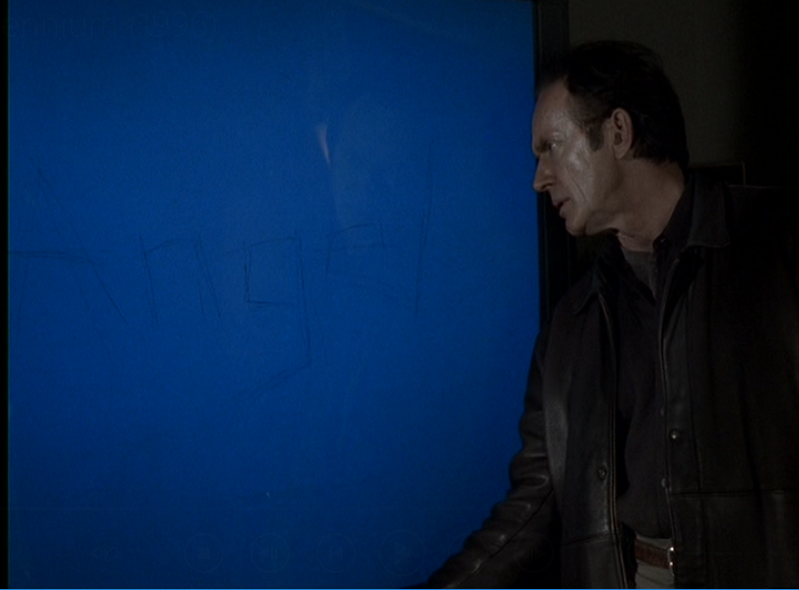
At that moment, Captain Bigelow of the Missouri State Police stepped up to introduce himself. After we'd made our introductions, he asked us if we knew Jim Gilroy. "We know him by another name," Peter began, "but yes, Frank pursued him while he was with the FBI."
"How violent is he?" Bigelow asked.
Peter replied: "He murdered three women in Virginia over a Labor Day weekend. The funerals had to be...closed-casket."
I quietly went on a self-guided tour of the house. A full-length mirror in one of the bedrooms caught my eye. Looked like it had been shattered in a struggle. Nasty one, at that--the mirror was bloodstained close to a large shard that had fallen out.
Putting on a pair of rubber gloves, I made my way to the bathroom. Sure enough, there was a bloodstain in the tub. As I looked up, the mirrored medicine cabinet presented to me my reflection. (Astonishingly, the glass did not immediately shatter.)
A vision flashed before my eyes: A woman was looking at herself in the mirror and crying. Suddenly she shattered it with her fist. She turned on the bath and, with the large shard, sliced open her wrist.
The vision ceased. Officer Bigelow might know something about all this.
"Killean Haskel," he told me. "She bled to death in the bathtub, and they buried her yesterday. Coroner concluded that it was a suicide."
"You might want to reconsider that," I said. We were in what looked like their daughter's bedroom. I picked up a photo album from the night stand and opened it. The first thing we saw was a prom-night picture of a young couple, dressed to the nines, followed by wedding pictures and Polaroids taken in various places.
"Is this Killean Haskel's husband?" I asked. "Must be," Bigelow replied. "As far as I know, she was divorced."
"Did they have any children?"
"Daughter. Madeline Haskel, now 20 years old. She lived here, too...We haven't located her yet."
I looked at the bloodstained sheets on the bed. Another vision, this time of Jim Gilroy straddling a terrified Maddie. The scumbag licked his fingers as she screamed.
"Have you typed and cross-matched the blood?" I asked Officer Bigelow.
"I'll get a tech to take a sample," he said. "We assumed it was the mother's."
"We need to find the daughter," I concluded. "She might know something that could help us."
===========================================================
Later that evening, Peter and I were at the Missouri State Police's barracks. The three of us--him, Bigelow, and myself--were watching video of the state trooper's death at Jim Gilroy's hands.
"Looks like the trooper took the proper approach," Bigelow said. "Seems he just didn't see the gun."
As I jotted down the license-plate number--RH7-487--a flicker of movement on the right-hand side of the screen caught my eye. "Pan right," I ordered. Peter complied with a few keystrokes.
"Is there a report?" I asked as Bigelow gave me a complete forensics report. "Killer used armor-piercing rounds," he said.
Peter interrupted him. "Wait--Jim Gilroy never used a gun. He garroted his victims. Cut them."
"Hold on, hold on," Bigelow exclaimed. "Are you trying to tell me that Jim Gilroy didn't kill my trooper?"
"You know him as Gilroy," I countered, "but we know him as Jake Waterston. He's neither rash nor careless. He wouldn't have acted on impulse unless he believed that his new identity was being threatened.
I turned to Peter and asked him to go back. We saw something move in the passenger's seat.

"That's not Gilroy. He's six-foot-two, and whoever's in there is much smaller." I flicked through the report. "Oh, look at this. There were two blood types identified: B-negative and A-negative. We know that Gilroy's is A-negative...but the video doesn't show the driver getting hurt or anything. Maybe Gilroy isn't driving."
I closed my eyes to think for a second, and the answer came to me. "The passenger is Maddie Haskel. If Gilroy were driving, she'd have been dead already."
"Well, if Gilroy isn't driving, and if he isn't the passenger...then where the hell is he?" Bigelow asked. ============================================================
It was about 1:30 in the morning. I went back to the Haskel place to see if I could find another angle.
The best place to start would be the last place I'd seen: Maddie's bedroom. It's funny...Someone told me once that you can tell a man by what you find on his bookshelf. Hers was mostly children's books, but a big red volume labeled "WEST HIGH SCHOOL" along its spine called out to me.
I flicked through the pages, and was soon rewarded with a picture of Maddie Haskel. Underneath, I saw a handwritten message: "Dear Maddie--See you soon after BASIC TRAINING. then you're mine. Love, Bobby W."
"Bobby W.," huh? I made a beeline for the very back of the book. I found a Dean Walker; a Bart Wear...and, finally, a Robert Webber. Black curly hair, handsome in a James Dean kind of way...but I remember those eyes most of all. They burned with an unsettling fire...They leant an intense, bordering on insane, aura to his features. Did he aspire to the Army as a means of controlling his unstable impulses...or feeding them? The second seemed more likely. (By the by, I never went for that whole "you're mine" thing so common in teenage love stories. It always manages to end badly.)
Most of the time, the yearbook will ask the kids to write something about themselves, and his was simply "Being all I can be."

I kind of figured.
As I closed the book, a pile of envelopes, all stamped, fell out. One of them, stamped and unsealed, was addressed to "Angel Haskel." Now, let it be known that it's usually not good form to read someone else's mail, but the normal rules of etiquette go out the window when lives are on the line.
"Dear Angel," the letter began, "I never told you about the night you left. I'd gone out for groceries, and when I came home, you were gone. I was terrified. I was lost. I couldn't get a straight answer out of anybody. I must have driven for hours looking for you, but there was no sign. I got tired and kind of gave up. I'm sorry. I'm sorry I gave you up on that night. Please forgive me."
I found another one, marked "December 24th."
"Dear Angel, it's Christmas Eve. I remember when I was ten years old and I caught Momma putting presents under the tree. Broke my heart. Believing in Santa was the last bit of little-kid mystery left in the world. I'm looking up at the dark, winter sky right now, wishing that weren't true, wishing that old guy in the red suit would bring you home. I miss you so much. I got to go. He hates it when I write to you. I can hear him coming up the stairs."
As I read those words, I too heard footsteps. It was Peter Watts.
"Did you find something?" he asked.
"Just some letters. I think they're to her father," I replied.
"Records show that his name was John Haskel. He split...long gone."
"Left some deep wounds, though."
We heard a car pull up. Through the window, a police car's red and blue lights flashed. It was Bigelow, with news for us. "We found Jim Gilroy's car, in Springdale, Arkansas, about two hours south from here."
If my suspicions were right...and they usually are...then we had to catch up to our lead in a hurry.
We got to Springdale just as a tow truck pulled the car out of the water. Two troopers busted open the trunk with crowbars. Inside was Jim Gilroy, nee Jake Waterston, his face badly bruised and bloodied, his lungs full of water, and a bullet hole in his thigh.

Jim, Jim, Jake...Karma's a bitch, don't you think?
==========================================================
A couple of hours later, Peter and I paid him a visit at the hospital.
They'd put him in the jail ward. Bigelow and a trooper named Flanagan were in there, grilling him. Sad to say, they were getting nowhere: the jailbird refused to sing. I decided to make my move.
"Who was Maddie riding with?" I asked. He feigned ignorance, but I knew better.
"I know you," I continued. "You used to live at 898 Gadsden Place, Newport News, Virginia. You worked at a mill by the docks, and drove a '73 Impala. Your real name is Jake Waterston and you killed three women. You have no reason to lie."
I saw it in his eyes: he knew the game was up. "They beat me and left me in the trunk. Ever stop to think that I'd be dead if not for the air pocket in there?"
"Not in the way you do. Who's Maddie riding with?"
"Her boyfriend, Bobby Webber. He got me 'cause I wasn't ready for him."
"What did you do to Maddie?"
"Nothin'."
"You killed her mother."
"That hothead? She killed herself."
"You let her. You perpetrated the abuse on Maddie."
Out of the corner of my eye, I noticed Peter Watts coming in through the security gate. Time to play my last card.
"Who's 'Angel'?"
No reply. Of course.
I knew I wouldn't get any more out of him, so I took my leave of him and went to talk to Peter. He turned out to have some good news.
"I found Maddie's father. Turns out he was an inmate at the Fond du Lac Correctional Institute in Waupan, Missouri. He died there last year, and he's buried in an unmarked grave in a potter's field close to the prison."
"...Maddie must be after something else," I said, almost to myself, as I left the hospital. I needed some cool air, and time to turn things over in my head.
My mind flashed back to those letters. She must have known that her father was dead. The writing of those letters didn't add up, though. She'd written them in the present tense. Were they a confessional...an oral history...or...or...
The answer hit me like a strong vodka-and-tonic, but I'd need Maddie's medical records before I could confirm my suspicions.
==========================================================
Later the next day, at about 6:30 in the morning, we gathered at the Arkansas State Police headquarters, and sat down to look at Maddie's medical records.
Sure enough, we found a birth certificate from St. Mary's Hospital for Angel Webber, born on July 14th. Neither of us knew what had happened to the baby, but I had an idea...an unpleasant one, I admit. Just to be sure, I'd need to access Jim Gilroy's bank records. Peter Watts found a phone line and set up an Internet connection with his laptop.
A few minutes later, he'd found something. About ten months ago, Jim Gilroy received $7,000.00 in his bank account...wire transfer. It was only two months after Angel was born. I could only conclude that he'd bought Maddie's baby, sold it, and bought himself a TV. The wire-transfer came from the account of a lawyer named Rudolph Barnard.
A little more investigation revealed that Angel was adopted by the Travis family in Little Rock. The state police immediately sent out three squad cars after they placed a call and got no answer.
==========================================================
By the time Watts and I got there, it was already a hostage situation. The cars were lined up outside the house, parallel to each other, and the cops all had their sights at the front door. Oh, it was tense, I tell you--nobody dared to even so much as breathe, lest some fool pulled their trigger too soon.
In a split second, the sharp CRACK of a freshly-fired gun popped the atmosphere around us like a pin to a child's balloon. Somewhere around me, a radio blared out a frantic set of orders.
The door opened. Out came Maddie, her face totally blank and her lower lip bleeding slightly. I begged the firing-squad around me to stay their execution, and I ran to her. "It's over, Maddie," I said, as I took the gun from her limp hands. No resistance at all.

A quick peek inside showed me everything I needed to know: The Travises were still holding the baby, and Bobby, at the foot of the stairs, was dead. Looks like she took his gun, then he hit her; and finally she'd had enough and gave him what was coming to him.
No more problems.
========================================================
A little while later, I paid Maddie a visit, had a friendly chat. We were in a small interrogation room at the prison where she was serving her sentence.
"The Travises send me a picture once in a while," she began. "I asked them not to tell Angel anything about his mother...He'd have just grown up to be another Bobby, another Jim, another man just like my father. You saved me that day...You're the only man in my life that ever did anything nice for me."
A guard interrupted us. Time's up.
"I spend my time thinking of Angel. Prayin' that he ain't thinkin' of me."
Sometimes, you see, happy endings aren't always what you'd think they should be.
=======================================================================
COMMENTARY
Most of Millennium's first-season episodes follow a "catch-the-serial-killer" template, usually with some other kind of twist thrown in for good measure. The first few episodes--"Pilot" up to about "Blood Relatives"--have been pretty straightforward, but now we're starting to see the series work its magic with other narratives and genres.
This episode, "The Wild and the Innocent," is a sequel to and inversion of "Blood Relatives," in that it's about a young mother, on the run from the law, searching for her biological infant son, whereas the earlier episode involved a young man in a halfway-house searching for his long-lost birth mother. Interestingly, both episodes end in the same way: the mother rejects the child. In "Blood Relatives," it's because she wants nothing to do with him having seen what's become of him; in "The Wild and the Innocent," it's because she realizes that he's better off with his adoptive parents.
...Actually, the episode is also playing with another narrative, that of "the killer from the hero's past returns and starts killing again." Considering that this is Millennium we're talking about, there's a twist: The killer is the victim this time around, having nearly drowned in the trunk of a sinking car.
There's honestly little else I can say about this one, other than "it's extremely dull." There's little of any value for me to comment on, and even the esteemed Lance Henriksen seems to be phoning it in.
What's more, he and Terry O'Quinn (Peter Watts) are at times saddled with ludicrous dialogue that no human being would ever spout in real life (O'Quinn, perhaps channeling Mr. Spock: "...The morticians were unable to satisfactorily reconstruct the bodies." Henriksen, as Captain Obvious: "An inordinate amount of violence and suffering has occurred in this house.").
Worse still, the lines are delivered in the most deadly-serious way possible, and the whole affair inadvertently takes a turn for the hilarious. Seriously, I just burst into hysterics whenever I read those lines!
All in all, "The Wild and the Innocent" could have used another revision or two.
Hopefully, the series will pick up some steam again come next episode.
====================================================================
(Millennium copyright Ten Thirteen Productions and 20th Century Fox Television. All screenshots are property of Ten Thirteen Productions and 20th Century Fox Television. All rights reserved. Special thanks to Millennium--This Is Who We Are for episode transcripts, which helped me adapt the episodes.)
This episode, "The Wild and the Innocent," is a sequel to and inversion of "Blood Relatives," in that it's about a young mother, on the run from the law, searching for her biological infant son, whereas the earlier episode involved a young man in a halfway-house searching for his long-lost birth mother. Interestingly, both episodes end in the same way: the mother rejects the child. In "Blood Relatives," it's because she wants nothing to do with him having seen what's become of him; in "The Wild and the Innocent," it's because she realizes that he's better off with his adoptive parents.
...Actually, the episode is also playing with another narrative, that of "the killer from the hero's past returns and starts killing again." Considering that this is Millennium we're talking about, there's a twist: The killer is the victim this time around, having nearly drowned in the trunk of a sinking car.
There's honestly little else I can say about this one, other than "it's extremely dull." There's little of any value for me to comment on, and even the esteemed Lance Henriksen seems to be phoning it in.
What's more, he and Terry O'Quinn (Peter Watts) are at times saddled with ludicrous dialogue that no human being would ever spout in real life (O'Quinn, perhaps channeling Mr. Spock: "...The morticians were unable to satisfactorily reconstruct the bodies." Henriksen, as Captain Obvious: "An inordinate amount of violence and suffering has occurred in this house.").
Worse still, the lines are delivered in the most deadly-serious way possible, and the whole affair inadvertently takes a turn for the hilarious. Seriously, I just burst into hysterics whenever I read those lines!
All in all, "The Wild and the Innocent" could have used another revision or two.
Hopefully, the series will pick up some steam again come next episode.
====================================================================
(Millennium copyright Ten Thirteen Productions and 20th Century Fox Television. All screenshots are property of Ten Thirteen Productions and 20th Century Fox Television. All rights reserved. Special thanks to Millennium--This Is Who We Are for episode transcripts, which helped me adapt the episodes.)
Subscribe to:
Posts (Atom)