Sunday, June 15, 2014

Happy Father's Day 2014!

Right, first things first: The image in the left and right boxes on the banner is supposed to represent a necktie.

Before I write anything else, I'd like to share the immediate future of the Museum with you:

I'm going to have a few themed posts once Baseball Season rolls around. The centerpiece of these posts will be a set of 26 trading cards depicting the USA 2000 baseball team at the Sydney Olympics.

For Halloween, I do have Dracula 2000 and maybe the TV series Millennium on the shortlist of things to be covered.

Hmm...There's a little space for "Back to School" on the agenda. I'll take a look and see what I have left over in terms of books.
-------------------------------------------------------------------------------------------------------


Date: unknown. Manufacturer: unknown

I found this most unusual tie at the Flamingo Island Flea Market in Bonita Springs, FL, while I was on vacation. At the moment, I regret not getting a better detail on the tie, because this is definitely one of the Museum's weirder exhibits. At the bottom of the tie, you can see "2000" stacked in yellow and green. That's fairly obvious. Here's where it gets head-scratchingly strange: Three Holstein cows are frolicking around the main logo; above them, white "2000" logos are done in a graffiti-like font. 

I'm not entirely sure what cows have to do with the year 2000. Internet searches aren't turning up anything, and there wasn't a manufacturer on the back of it, so I'm not going to have a cow over it (pun certainly intended). Into the "Miscellaneous" section it goes!


Date: 2000 vintage. Manufacturer: unknown

Another item I found while on vacation, this throw is without a doubt 2000 vintage. The amazing thing about it is, I didn't even know we had it until now! Chances are, Mom got it because it had those Nightmare Before Christmas-like spirals on it, without any connection to the new millennium. 

It was an elegant black-and-white once, but time and storage have conspired to discolor it into chocolate brown and ecru. The spirals, stars, and other decorations are meant to be New Year's confetti, and in the middle of all that is "Celebrate 2000!" in a font that I can't presently identify, but I have seen it before somewhere. It's something named after an artist...I'll have to check and see what I wrote in an earlier draft.

Friday, June 6, 2014

♪♫If there's something strange in the Museum...♪♫

...then it must be:


(In case you were wondering, the banner and tag image is a little something I cooked up in Paint a few days ago. It's a representation of the animated Ghostbusters title-card from the beginning of the movie, at the moment before the No-Ghost fully forms.)


2014 marks the thirtieth anniversary of a movie that needs no introduction. 1984's Ghostbusters has rightfully earned its place in the pop-culture pantheon with a tightrope act of smart-aleck laughs and effects-driven scares, an instantly-recognizable theme song, and a cockeyed take on the supernatural that pays homage to (and wittily punctures) earlier movies such as Poltergeist and The Exorcist.
Here at the Millennium Museum, we’re celebrating that anniversary by turning the clock back to 1999 with the 15th Anniversary DVD.
 
The packaging itself (above) represents a complete departure from all other releases that came before. The plain, black box of old, decorated with the movie's original poster, is out the window; in its place is a splashy new cover with our four heroes in front of New York's skyline, ready for battle. This movie's tagline is their slogan, "We're Ready To Believe You;" the second movie's is "Be Ready To Believe Us."
The disc itself...now, this is where it gets interesting. I do believe that Ghostbusters was one of the first ones to demonstrate what the DVD format was capable of.  Immediately after the old Columbia/Tristar Home Video logo (before Sony Home Entertainment became the standard logo), viewers are presented with a wonderful animated menu based on New York City. Spirits swoop across the screen, Slimer whirls around Gozer's Temple atop 55 Central Park West, and the Stay-Puft Marshmallow Man takes a stroll down the street. A virtual camera pans up, down, and across the main map with each selection.
It doesn't stop there: This baby is loaded with extras, from the original “On Call with the Ghostbusters” documentary from '84, to all-new (for 1999) featurettes on cast and crew. The “Visual Effects Featurette” is a particular highlight. There are also trailers for GB I and II; Stripes; and Groundhog Day, as well as a full complement of concept art, special-effects before-and-after comparisons, pop-up production notes (taken from Don Shay's book Making Ghostbusters), and the movie's signature feature, the “Video Commentary,” which marries fully animated Mystery Science Theater 3000-style silhouettes to an audio commentary by Harold Ramis (co-writer and “Egon Spengler”), Ivan Reitman (director), and Joe Medjuck (producer). The video feature can be toggled on and off, and it adds a further dimension to an already highly-entertaining audio commentary. Harold Ramis, who very tragically died earlier this year, proved himself a thoroughly engaging raconteur on this commentary as he shared wonderful behind-the-scenes tidbits (the one where science-fiction legend Isaac Asimov grouched at Dan Aykroyd because the filming tied up traffic springs to mind) and a few digs at costar Bill Murray (never named, but it's obvious who he's talking about). As far as I know, this was one of the only titles to use the "Video Commentary"--even the more recent DVD and Blu-Ray sets eschew the visual part.

As for the movie itself, this is its first mass-market widescreen release. There was a widescreen/letterbox VHS version in the early 90s, but this was hard to come by and only available through specialty stores like Suncoast and Saturday Matinee (ah, the good old days...). The earliest VHS release was horribly cropped for average TV sets, to the point of cutting Egon and Winston out of the picture most of the time and ruining some of the jokes!
The remastering and color-grading is top-notch, with a crystal-clear picture that eliminates the slight “grain” and pale coloring of the earlier release. It's pretty much as one would have seen it in the movies back in 1984. The sound mixing is first-class; the DVD and 15th Anniversary VHS alike use Surround Sound.
And now, the million-dollar question:
Why do I list it on this blog?
Considering its 1999 release, many of the extra features reference the then-upcoming 2000 celebrations, and on the '99 Featurette, Dan Aykroyd muses that the change from 1999 to 2000 might stir up some thoughtful discussions about Ghostbusters' ideas on the afterlife and things like other dimensions and planes of existence.
One thing is certain: Its fears of apocalypse, especially in the lead-up to the climax, certainly resonated. In those scenes, people of all religious faiths—Jewish, Christian, Muslim, Buddhist, every faith—gathered in droves to pray for the safety of this world. All the differences between the faiths were, for a moment, secondary to the doom surrounding them. That sense of unity is what the Millennium Dream is all about, the idea that the individual groups of people that comprise humanity can focus more on what makes them alike and less on what makes them different. (During the commentary, Harold Ramis proves himself more down-to-earth about the whole thing: “All that money spent on DVDs for nothing,” he wisecracks.)

As an aside, it's worth pointing out that the front cover displays the two towers of the World Trade Center. To think that such an icon of the modern world would be erased from the landscape just one year after the dawn of a new century...This release of Ghostbusters is a testament to the innocence of 1984 and 1999 alike.

Sunday, May 25, 2014

SKREEEEOOOONK! It's "Godzilla 2000!"

In honor of the new Godzilla adaptation that opened about a week ago, and in the best tradition of having a big-budget blockbuster on Memorial Day, I, Mr. Millennium, hereby place Godzilla 2000 in the Museum's exhibit halls.

(Source: http://supermons2.angelfire.com/godzilla_invades_america/98posters.html)


I found this for $5.00 at a video store the other day, and, always one to recognize a good bargain, I snapped it up. Having popped it in, I learned that it actually is a 1999/2000 vintage, and not a re-release as I thought it might be.

It has a new Columbia/Tristar DVD logo, unlike the one featured on next week's Ghostbusters DVD—this one is slightly darker, and has letters that “fly in” and all sorts of neat stuff. It has an all-new animated menu, and when you hit “enter” on one of the selections, a missile flies toward it and explodes. Pretty cool!

That being said, I have some bad news for the purists out there: This release is dub-only—no original Japanese language selection. While I usually prefer the dubbed versions of anime, I don't care for it in live-action, especially if it's not done that well.

On top of all that, I found the action unengaging. Only Godzilla himself gets to lumber around—the movie itself has to get itself to a good, churning boil to counter its star's slow pace. For that it needs good, involving characters, and Godzilla 2000 has a cast that I just can't bring myself to actually care about. There's a Lois Lane-type trying to make her break by getting pictures of Big G; a couple of scientists who discover the big guy's speed-healing properties; the “Godzilla Prediction Network,” who tool around in a cool, ECTO-1 looking vehicle (I half-expected them to use a “No-Ghost” parody as their logo, but alas); and a couple of military and corporate types.

The plot...I found myself kind of amused at its riff on Godzilla's spiritual ancestor, H.G. Wells' The War of the Worlds. Here, a group of scientists discover a gigantic meteorite (a la George Pal's 1954 adaptation) under the ocean. Apparently, it derives its power from the sun, and they're trying to use it as some kind of wild new energy source to get Japan off nuclear power for good. I do believe that much of this story is informed by the Tokaimura incident, which happened on September 30th, 1999; no doubt many still had it “on the brain.”

Monster and meteorite cause mutual havoc for the human world (its version of the Heat-Ray is powerful enough to make even Godzilla himself sweat!), and in the big climax, the thing turns into a futuristic take on Wells' three-legged Fighting-Machine. Aliens go bye-bye; big guy goes back to the sea bed; all's well that ends well. I don't really feel like I'm spoiling anything, 'cause there's not much more to it than that.

Toho released it as Godzilla 2000: Millennium. Sadly, there's precious little Millennium about it except for the title. The story probably could have involved the event, whether by tying the meteorite in with it, or by saying that Godzilla needed a tux for the Kaiju Bash (the mind-boggling logistics needed for such an event would probably make a good movie in and of itself), but...regrettably, this is not the case. 

All in all, Godzilla 2000's lack of grounding in the New Millennium and its smash-by-numbers air make it a necessary if undistinguished addition to the Museum.

Thursday, May 1, 2014

An uncertain future for the Museum?

The Museum's halls have been fairly quiet lately, I admit. Don't worry; I'm not closing the place down yet. It's simply that 1) life has been demanding a lot more of me than usual, and 2) I'm running out of Items to post! I'll keep doing the Revisited series when I can, but I need to look for more things. I'm about to go on a vacation to Florida in a few weeks, so I'll look into hitting a couple of flea markets and resale shops while I'm there. Making no promises, but they should yield some interesting results. I do have "Dracula 2000," "Godzilla 2000," "Pokemon The Movie 2000," and the series "Millennium" at the back of my head, but most of those should be for Halloween. Ooh, here's an idea: Saturday, June 7th, is the 30th Anniversary of Ghostbusters. It might be a good idea for me to review the 1999 "15th Anniversary" DVD, and its first DVD release. As far as I know, it was one of the first titles to really show off what the format could do, because it's packed to the gills with documentaries, concept art, storyboards, animated menus, and scads of other features. The standout is the "Video Commentary," during which writer Harold Ramis mentions the New Millennium. I'm not saying a word about the context, but let's just say that it casts the movie in a whole new light.

Thursday, April 3, 2014

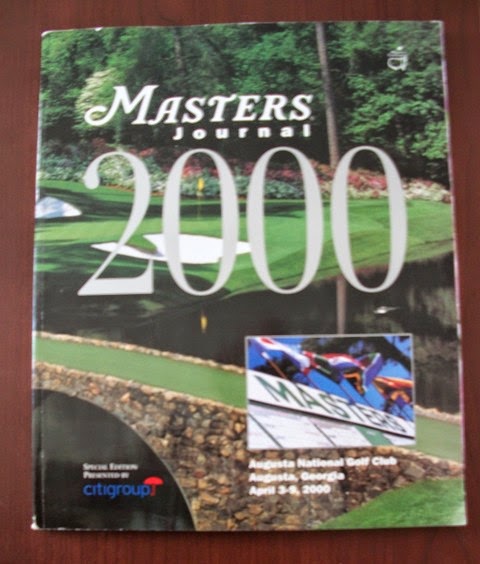
FO-O-O-ORE! It's the Masters' 2000 Journal!


Let me begin this article with an admission: I am not an avid sports fan. Certainly, I’ll check in on the Super Bowl, the World Series, and the Olympics (though Sochi was the first Olympic Games that I actively avoided), and I’ll take in the awe and spectacle, but afterwards, it’s all just a game to me.

The same applies to the Masters, which is, in a word, the World Cup of golf. I bought this journal not because I follow golf, but because 1) it’s a Year 2000 item, and 2) that year, the Masters opened on my birthday (April 3rd). It came from the St. Vincent de Paul Thrift Store in Midlothian, IL, where I've found one or two very good Millennium Artifacts in the past year. 
(Oh, just as a heads-up, the Masters Tournament will start next Monday.)
…So, the Masters 2000 Journal. At the time, Citibank (or Citigroup, as it was known) provided backing for the tournament, and there are one or two ads for the corporation. At the time, Citibank had just bought Travelers Insurance and undergone a huge rebranding effort. Gone were the days of the italicized, all-caps “CITIBANK” logo—gone were the days of “CITIBANK,” actually—this marked the age of “CITI” and “CITIGROUP” in a simple, all lower-case font. Also, the red Travelers umbrella appeared at the end of the word “Citigroup;” it’s now a stylized red arc that sits on top of the “t” and covers the two “i’s.”
Enough about banking and financing; what about the rest of the book? It fits the “time capsule” mandate of the Millennium Museum quite well. It starts out with a five-page section about the Masters’ humble beginnings, and after that there’s a decade-by-decade “potted history,” which recaps each year’s tournament, tells us who won that year, and offers up a few interesting highlights. For example, in 1997, a 21-year-old Tiger Woods became the youngest winner in Masters’ history.
The entry says, “…Tiger Woods re-wrote [sic] a good portion of the tournament’s record book. His 270 total and 12-stroke margin of victory were two of 20 records the 21-year-old established. His play in Amen Corner—seven under par for the four rounds—was instrumental in his becoming the youngest Masters champion” (Masters 25).
The book only goes up to 1999—I assume this is because it was released well before the 2000 edition had even begun. The winner that year was Spain’s Jose Maria Olazabal, who had previously won the British Boys’ tournament; the British Amateur Championship; the British Youths’ tournaments; and the 1994 Masters (Masters 44). Few people knew at the time that Olazabal was playing through a foot ailment that first started in 1993, and after he won in ’94, it got so bad that he needed surgery.
By 1995, he was almost completely debilitated.
In 1997, he sought the help of a Munich-based specialist, who diagnosed him with “nerve pressure in his lower back that was affecting muscles in his feet” (44), and so began his recovery. Though he was always humble, Olazabal’s illness put everything into a new perspective: “After what I have been through, golf gives me a different feeling, a determination…I’ve had the chance to have the best cars and to be able to build a house with enough room to bring my parents to live there with me. I am paying them back. That is what I enjoy, to see them happy” (45).
The next section of the book is a play-by-play dissection of the course. Each of the eighteen holes takes its name from a flower (Holly, Azalea, etc.), and each has its own difficulty grade. You may recall a passing reference to something called “Amen Corner” earlier, and now is a good time to explain what that is—in fact, the section opens with “Prayers at the Heart of Amen Corner.”
Though it’s officially named Golden Bell, the twelfth hole on the course has quite a nasty reputation. To put it simply: As Blackbeard once struck terror in the hearts of merchant sailors, Amen Corner strikes terror in the hearts of hardened professional golfers. If you beat it and still remain under par, it will be by an act of divine intervention, hence “Amen.”
Its reputation is fourfold: First, Rae’s Creek serves as a giant water trap. Second, the putting surface is “100 feet wide but just 27 feet deep at its narrowest point” (72), which is itself surrounded by three sand traps, or “bunkers.” Third, the course is designed so that the hole is on top of a small hill. Fourth, and finally, an ill wind can send the ball rolling down that incline.
Here’s a good article about this most feared part of the tournament: "Amen Corner: What's in a Name?"
 
The final section of the book is a list of the 92 competitors that year. Among them were Tiger Woods, Jack Nicklaus, and Arnold Palmer, as well as Vijay Singh from Fiji and Nick Price from Zimbabwe. I’m not going to go into detail about this part, but Masters.com has plenty of information available.


Sunday, February 16, 2014

The first in the "Revisited" series.


When I first opened the Millennium Museum, the original intent was simply to catalogue and comment on items I already owned or had yet to encounter, and there was a heavier emphasis on “collecting.” It wasn’t until much later on that I started to notice and pick up on recurring themes within each item.

From there, what began as a checklist gradually turned into a jigsaw puzzle; the weekly posts served to complete the larger picture. (Is it a conventional jigsaw puzzle or one of those “Puzz-3D” things that were so popular around 2000? I’m not really sure.)

With the new focus in mind, I looked at the older stuff from almost all of Series 1 and 2. The articles lack content, depth, and plain old “good writing,” but within that you can see how the Museum itself has grown and changed over the course of a year.

The “ABC 2000 Millennium Highlights” video should be the best place for me to start. I’ll be blunt: I’m sorely, sorely disappointed with what I wrote for it—a picture and a short paragraph with a snarky, unprofessional tone. In context, though, the Museum started as a Cake Wrecks-type blog, and I thought I wouldn’t need to put too much work into it. 


I bought this videotape in June 2012 at our local Salvation Army Thrift Store. I’d already been there several times, and the place had at least three dozen copies on the shelves. Naturally, I looked right past them every single time…until 2012, when the different concepts and items that would eventually form the blog that you’re reading right now first came together. In fact, this was the first thing I actually bought specifically for the site. The original idea was to report on things I already owned, but I realized that sticking to that plan would mean exhausting my material.

Right at the beginning, this is a record of recent history; a snapshot of a moment in time. We’re seeing the classic ABC News lineup—Peter Jennings, Diane Sawyer, Sam Donaldson, and the others, all at the height of their power and jubilant at the prospect of a new century. Together, they take you all around the world, and you get to see how countries such as Russia, Australia, France, the United Kingdom, China, and many others rang in the New Millennium.

The program on the tape looks primitive compared to what we’re used to today, but I think that’s only because it’s actively trying to look high-tech. We’re marking our journey around the world with a spinning CGI globe, which was actually pretty well-detailed and lifelike for 1999/2000. The set looks a little bit old-fashioned in places, but again, that’s what we were used to. Nowadays, everything looks modern by virtue of looking timeless. (I’m convinced that much of the “set” we see on the major network news shows is a green-screened background with a few physical elements.)

Our first stop is the island nation of Kiribati, which competed with the neighboring Tonga to be the first one to ring in the New Millennium. The small nation successfully petitioned to have the International Date Line, at the 180th Meridian, moved so that all of the islands within that area could celebrate at the same time.  Fourteen years after its little victory, however, Kiribati is in some major trouble: Sea levels have risen thanks to climate change. Most of its inhabitants have fled to neighboring Australia, New Zealand, and Fiji, but they no longer have a place to call home.

Peter takes us to Tonga, Fiji, Australia, and finally to New Zealand, where he has a chat about possible Y2K problems with Jimmy Walker of New Zealand's National Incident Monitoring Center. Mr. Walker cheerfully states that there are no problems outside of the national analog cell-phone network being jammed (par for the course on Christmas, Mother's Day, etc.) He also pulls out an ATM receipt dated 1/1/00, 3 seconds into the new year.

We zoom to London, where we join Charlie Gibson. Here, in our “preservation of history” segment, we get a history lesson about “Auld Lang Syne.” Way back when, Scottish poet Robert Burns traveled throughout his home country, collecting poems along the way. “Auld Lang Syne” was one of these—it's stated that he overheard an old man singing it, and he immediately transcribed it. Later on, Burns would clean up the verses and add a new melody. Its title literally translates as “for old time's sake,” and it was a traditional parting song. As the people of Scotland left in search of a new world many years after Burns died, they took the song with them. Many people heard that song, most notably a big-band conductor named Guy Lombardo. To this day, ABC's “New Year's Rockin' Eve” special plays that Guy Lombardo recording at midnight (New York time).
 
More interesting is Cokie Roberts’ coverage from Vatican City. At the time, she did coverage for ABC World News Tonight, and, as she mentions in the video, her mother, Lindy Boggs (1916-2013), was the U.S. Ambassador to the Holy See, a position now held by a one Ken Francis Hackett. In a special mother/daughter interview that went out, Ms. Boggs said that, for her, the best part of the past century was having “members of the family who are able to express what our country is all about; what world peace is all about; and what this celebration is all about….This celebration is absolutely marvelous.”

Meanwhile, in Bethlehem, we hear the following from field correspondent Bill Blakemore: “This is the night they’ve been waiting for a long time…The year 2000 is supposed to be a year of great peacemaking here in the Middle East, with the Israelis, Syrians, and Palestinians, all in different peace negotiations. There is some hope here that, by the time this millennium year is over, it will be, as one Israeli said, ‘a very different Middle East,’ with the Israeli conflict well towards being something in the past.” Unfortunately, this has not come true. On Tuesday, February 12, 2014, the Syrian cease-fire agreement ended, and the fate of the region is uncertain. 

Most touching of all is Peter Jennings’ little chat with perennial New Year’s host and “America’s oldest teenager,” Dick Clark, who had hosted the “New Year’s Rockin’ Eve!” on ABC since 1972 and, for those of us born in the 80s and 90s, he was New Year’s Eve personified. Here he is, in his prime, with a healthy glow about him, and rarin’ to go for the ball to drop.

All that changed in 2004, when he suffered a stroke less than a month before the 2004/2005 New Year’s Eve broadcast (“At the stroke of midnight,” someone no doubt quipped). From that point on, Dick became ever more marginalized until his death in 2012. Ryan Seacrest now hosts the special, but it’s still “Dick Clark’s New Year’s Rockin’ Eve!”, and so it shall be for many years to come.

(I’ll pause here to mention that 2013’s celebration featured the most amazing tribute to Dick Clark. Throughout 2012, New Yorkers in and around Times Square wrote their memories of watching his specials and posted them in a special exhibit. On that New Year’s Eve, those memories showered out over the crowd as midnight confetti. That there was one of the very best sendoffs anyone could ask for.)

The Jennings/Clark interview carries even more weight when Peter mentions that he’s going to give up smoking as a new century resolution.

On that bright and innocent and jubilant night, the future seemed wide open.

On a bright and innocent day more than a year later, terrorists flew commercial airliners into the World Trade Center.

On that dark and markedly less innocent day, Peter Jennings’ old habit came back in full force in response to the horrifying events that had transpired.

On August 7th, 2005, lung cancer claimed Peter Jennings’ life, just as 9/11 claimed the life of the Millennium Era, and with it, the dream of living in a fully interconnected and empathetic world.

That's what the Millennium Museum is all about...keeping the memory of that dream alive.


Sunday, January 26, 2014

Adding a new concept: "The Millennium Museum Revisited"

Okay, let me make one thing clear: I'm having major problems with designing an exterior structure for the Museum. (This is why I didn't take up architecture as my major...) I just can't seem to come up with anything that actually works!

Therefore, I'm ditching the whole "how the Museum might look in the real world" concept for now. Instead, I'll dig into the older Items and take a second, more in-depth look at them, this time keeping in mind how they fit in with the larger framework of the lead-up to the year 2000. These articles will fall under the umbrella banner of "The Millennium Museum Revisited," and will appear alongside newer material as I find it.