I cannot for the life of me believe it's taken this long to get to Star Trek.
Star Trek forms one-third of a science-fiction trifecta alongside Doctor Who and Star Wars. Please don't flood the comments asking me why; it's wholly arbitrary on my part. My reasoning is that these three are long-running franchises which made an indelible stamp on the public consciousness, from saying that someone with a heavy cold "sounds like Darth Vader" or knowing that Star Trek's communicators inspired Motorola's flip-phones.
Writer Gene Roddenberry conceived of the series in the early 1960s as a mélange of Forbidden Planet, Buck Rogers, Horatio Hornblower, and a TV Western called Wagon Train, in which a central cast traveled the frontier in covered wagons. (The similarities between Train and Trek end with the idea of having the central cast visiting other places and meeting guest stars.)
The series' first season was a hit, with writers such as Harlan Ellison and David Gerrold contributing cerebral, thought-provoking stories like "City on the Edge of Forever" and "The Man Trap." Past the quality of the stories, the original series lasted so long because of the camaraderie of the main cast, with the central trio of Kirk (William Shatner), Spock (Leonard Nimoy), and McCoy (DeForest Kelley) grounding the out-there premise with good humor and total commitment to their world.
Though the series lasted only three seasons, it lived on in reruns, at conventions, and in motion pictures.
My involvement with Trek began and ended with the second series, The Next Generation. At one point, I had a good number of the figurines and playsets, but none of the videos save The Motion Picture, The Voyage Home, and "pirated" copies of II, III, V, and VI, dubbed from Blockbuster's copies.
I started on Deep Space 9 two years ago, but never got around to finishing it or starting on Voyager and Enterprise, and I might get around to Disco? Very! and Picard one of these days. As for the J.J. Abrams movies...The first one was pretty good, but ultimately forgettable.
Picture courtesy eBay user jj_jazz
And, here is the Trek Millennium Collector's Plate. Starting clockwise at 3:00, we have the Enterprise from the TV series. At 6:00, what I believe is the Voyager. At 9:00, the Motion Pictures' Enterprise, which might be 1701-A. And, at 12:00, the Enterprise-D from The Next Generation. All four ships are coming out of warp and heading off to new adventures. As with most of the things on this site, this plate acknowledges the history of Trek while also looking toward the future.
I apologize for the lack of new content. Summer's been rough, rougher than all the other ones combined, and, despite the COVID-19 pandemic, I'm still working full-time.
...That, and owing to a couple of bad financial decisions, I can't buy new things to report on. And I still can't quite find the "hook" for Matrix Month.
But never mind. The Museum's eighth anniversary's coming up pretty soon. I'll get something going for that, OK?
Today is May 11th, 2020, and it's been twenty years since the drugstore chain Walgreen's opened its three thousandth store.
In 1901--just shy of the year 2000 being the company's hundredth anniversary--Illinois native Charles Walgreen opened his own drugstore after many years of working for other pharmacists and learning what they had and didn't have, and taking notes on customer service and other factors, all to figure out how to stand out. See, in the days before Walgreen's, drugstores were small, cramped, dimly-lit shops which sold drugs and medical supplies. That was it.
His longest employment was with Isaac Blood, with whom he learned so much that he one day grew confident enough to ask his boss if he could buy the store. Blood sold it to him...for $6,000.
Right away, Walgreen set to work. He installed bright lights and widened the aisles to make customers feel more welcome. He sold drugs that far exceeded the medicinal standards of the day. He and his associates personally greeted customers. He sold merchandise other than drugs so that his store became known around Chicago as "that one place you can go to when you need something right now and couldn't plan for because the need for it suddenly arose."
The store grew successful enough that it had grown to four outlets by 1916, by which time they had begun to look something like Mr. Gower's from It's A Wonderful Life--the soda fountain, the candy section. Needless to say, the company went from strength to strength, outlasting both the Great Depression and Charles Walgreen, Sr.'s passing in 1939.
The company got so successful that, in the 70s, it diversified into a chain of family restaurants, called Wag's, which stayed in business until 1991. I vaguely remember going to a Wag's at one point, back in........1991 or so; I believe it was over on 79th and Cicero, back when Goldblatt's had the department store there (it's now a Lowe's hardware superstore). All I remember is seeing the word "Wag's" on a pane of glass surrounded by some ferns, and recognizing the familiar Walgreen's font.
Anyway, here's the commemorative mug which Walgreen's sold when the three thousandth store opened.
As you know already, because I've repeated it ad nauseam for at least a year, 2020 marks the twentieth anniversary of the new millennium.
April 2020 marks the twentieth anniversary of my family's first steps into the Information Age. Though I can't remember the exact date offhand, it was a Sunday in late April 2000 when we piled into the car and headed to the Gateway Computers outlet in Orland Park. About the only thing I remember of the exact location is that it was close to the Barnes and Noble bookstore. What's throwing me off twenty years later is that I distinctly remember B&N sharing space on the outside of the silo with Gateway. Also, I almost never head out that way!
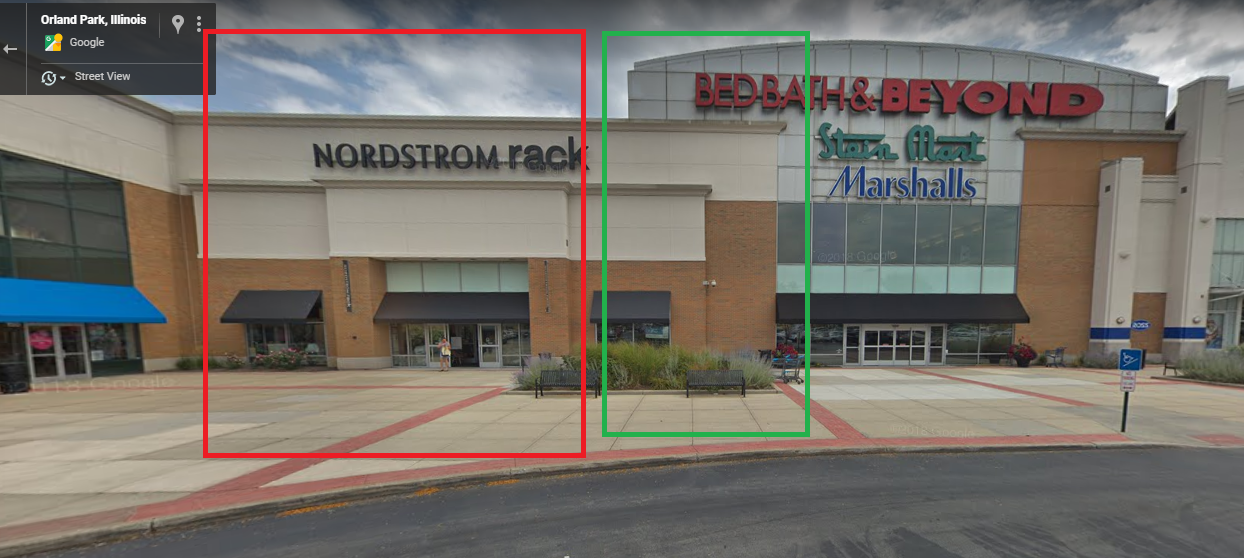
As the words were flying off my fingers, my mind's eye was going, "Did Gateway have the lower part of the silo, or did B&N have the whole thing and Gateway was somewhere else?" Thankfully, I can pull off a conjuring trick with the magic of Google Street View!
Aha! That's what was throwing me off! See where I've circled, that dinky little clothing store called "Justice"? As soon as I pulled that up, it occurred to me that I could run about four feet from Gateway to B&N. But there is another possibility, which I will elucidate below.
Notice how Nordstrom Rack cuts into and throws off the symmetry of Bed Bath & Beyond? The elongated arch of the central store is intended to be the centerpiece of this part of the shopping center, with the overall shape in full view. Dear readers, I will bet you, solely on my conjecture, that Nordstrom Rack occupies the space that one or two narrower outlets once occupied....and that's where Gateway once stood. Of course, as they say, "the memory cheats."
CORRECTION, 09/14/24: A few years ago, I asked on Facebook where the Gateway outlet was. Apparently, it was in the opposite silo where Hobby Lobby now sits.
Here is one of Gateway's commercials from, oddly enough, the year 2000, courtesy user VHS VCR.
The better part of a month passed, and the school year wound to a close. Some time in May, we went on the class trip to Springfield, Illinois' capitol. I remember...very little of it, but somewhere along the line, I bought this mouse-pad featuring the Declaration of Independence--still use it, in fact, but, after twenty years, the foam rubber on the bottom is crumbling away.
Come to think of it, I might have bought it in the gift shop at Abraham Lincoln's birthplace.
We arrived back at Central Junior High at around..........ooh, six o'clock at night, having driven through a dreadful storm all the way through. When Mom brought me home, the whole thing was set up and ready to go. The first game I loaded into it and played was the 1998 edition of Wheel of Fortune, because we used to have, ten years before the Gateway, an ancient, steam-driven, possibly coal-fired Hewlett-Packard one, loaded with, among other things, a host of games, one of which was Wheel of Fortune. Therefore it seemed only right that Wheel should usher in this new day.
Acknowledgments and thanks to Lazy Gaming Reviews
It came with two software bundles. The first included then-current encyclopedias and atlases, Broderbund's Print Shop Pro, Word, Works Suite, the lot. Unfortunately, I never got around to actually using most of it, mainly because grade school works wonders at killing one's love of learning, and seventh grade is especially good at putting the final nail into its coffin.
The second set--ah! The second was the games. Microsoft Flight Simulator; Jeopardy!; Microsoft Puzzle Collection; Pinball Arcade (no, not FarSight's Pinball Arcade); Clue; Sorry!; The Game of Life; Revenge of Arcade; Scrabble; a Small Soldiers game; and The Neverhood, a now exceedingly-rare Claymation game. Pinball Arcade and Revenge of Arcade...
And there was America Online. Yes, I belong to the generation for whom the 'Net sounded like this (thanks to Willterminus):
Ah, the olden days of HTML-based websites and games in Java and Shockwave. The two sites I visited most often for games were Alfy.com and the old Wonka website.
Videos in Apple QuickTime and RealPlayer, the old AskJeeves search engine, using Netscape at school, playing the Stock Market Game in eighth grade...oh, it was a time for the World Wide Web!
The old Gateway rig served us about five or six years. Of course you know, with access to the Internet comes the threat of malware, spyware, and viruses. Who knows how much of what flotsam and jetsam it picked up in those years?
In 2006, it got so slow and so noisy that we had to replace it with several other models from Computer Greeks. There was a big green one; a red one; a silver HP...all went the same way after several years of service each. Each was a learning experience, and I am now much more careful with what I download.
By this point, you're probably wondering why he's wittering on about a twenty-year-old computer that he no longer owns. Well, if we didn't buy that thing then, you might not be logging on to the Museum in the present day, and, since we bought it in 2000, then it ties in with the New Millennium theme. What's more, the way things have been going...gives me pause to re-evaluate those days and try to find the good in a few of them, and getting to write about them now is freeing.
Today is April 8th, 2020. We're still self-isolating thanks to the Coronavirus, and the news seems to get more depressing with each day.
In news that isn't depressing, ABC is bringing back Who Wants To Be A Millionaire as a twentieth-anniversary event, with Jimmy Kimmel hosting. In that spirit, it's time to dig back into the Museum's back catalog and dredge up a very, very, very, very, very old post.
Who Wants To Be A Millionaire? originally ran on
ABC from August 1999 to June 2002. It still runs as a syndicated show, but its
original incarnation is this week’s Millennium Artifact.
The network version featured a
“Fastest-Finger” round in which emcee Regis Philbin instructed eight potential
contestants to put four items into order, and the one who did it in the
shortest time reached the “Hot Seat.” Winnings accumulated from $100 all the
way to $1 Million, with milestones at $1,000; $10,000; and $50,000. The show
was notable for giving players a fighting chance with three Lifelines: Ask the
Audience; 50/50, which removed two of the “wrong” answers; and Phone-A-Friend,
in which AT&T connected the contestant to someone he or she “knew” would
know the answer.
It became a hit almost
overnight. The walls dripped with “Millionaire” everywhere you
turned. Monochrome ties inspired by host Regis Philbin's one-color
suit/shirt/tie combo were sold as “Millionaire Wear;” Pressman marketed a
“board game” with playing pieces that mimicked the show's superimposed
displays; Jellyvision (creators of “You Don't Know Jack”) teamed up with Disney
Interactive to publish a computer game, which I have here; and Disney Theme
Parks had the show as a feature at its California Adventure park. And, yes,
Tiger Electronics put out a cartridge-based handheld game along the lines of
its earlier “Jeopardy!” and “Wheel of Fortune” games.
McDonald's also had a “Millionaire”-themed
promotion similar to its annual “Monopoly” game, in which certain meal
combinations—usually Super-Sized items in those less health-conscious days—came
with removable game tickets. The “Millionaire” promotion is not fondly
remembered nowadays, thanks to seven employees of Simon Marketing, Inc., which
handles most of the restaurant chain's games. These employees planned to steal
the highest-winning tickets for themselves and their family members, but the
FBI foiled the plan.
The “Millionaire” phenomenon
really took hold when a one John Carpenter (no, not that one) became the show's
first Million Dollar Winner...without lifelines. Well...he used his
Phone-A-Friend at the very end to call his father, but only to announce that he
was about to Be A Millionaire. After
his victory, ABC ran the show every weeknight, with variations such as
“Celebrity Millionaire.” Sadly, this relentless milking of the cash cow proved
to be ABC's undoing, and, by 2002, the American public had grown sick of the
show. Thereafter, it went into syndication as a half-hour afternoon show, but
ABC celebrated its baby's tenth anniversary with a limited run in 2009.
I remember the “Millionaire”
craze. Without question, it was the big thing in late ’99 up until early
’02…in fact, besides the CD-ROM game, I also have a pair of quiz books called Is
That Your Final Answer?, which are filled with ridiculously easy questions
and answers.
As with all things, Millionaire fell from grace, and I would
argue that there were two reasons for this. First, it was all a bit “much;”
that goes without saying. Viewers had gotten bored with the show after so much
saturation.
But there’s another reason.
Take a look at that date…2002. By then, we, the viewers, had lost patience with
the show’s theatricality and grandeur, and maybe in the wake of the Enron scandal and the uncertainty that came with it, the era lost the "time of great wealth" aura it had gained. I'll explore that in a later issue when I review Harry Dent, Jr.'s book The Roaring 2000s.
I told you when I opened the
Museum that we would be exploring the “Millennium Era” from the perspective of
lost innocence thirteen years later. Indeed, it’s been a running theme in many
of the latest entries.
This Millionaire feature marks the closing of the Museum’s second
season. I leave you now with the question: “What does he mean by ‘lost
innocence?’”
When I reopen the Museum in
time for Series Three, we’ll answer that question. Until then, this is Mr.
Millennium signing off. Good night, everybody!
August 4, 1999: Though "The Blair Witch Project" officially premiered on July 30th, 1999, it became a pop-culture sensation by this time. I bring it up here because July 30th was a weekday. :)
August 4, 2000:
Robert Downey
[Jr.] Is Drug-Free, Lawyer Says--Many years later, this seemingly-washed-up star experienced a second renaissance as "Iron Man," in which he played the alcoholic billionaire Tony Stark.